Showing posts with label integration. Show all posts

Sunday, November 6, 2016

[AM_20161105ITFF] False Friends in Integration (Calculus)

Question

Introduction
          False friends are words in two languages that look/sound alike, but differ significantly in meaning.  Do you know that there are also false friends in mathematics?  Can you distinguish and explain the difference between the two integrals?

Solution

          The integrand on the left has the variable  x  as the base and the constant  e  as the index.  So we integrate it using the Power Law.
          By contrast, for the integrand on the right, the base  e  is a constant whereas the index is the variable  x.  Integrating  e  to the power of  x  is the eeeeeeeeeeeeeeeasiest.  You just get back the same thing, plus the arbitrary constant of course.

Remark
          Many students make the mistake of trying to apply the Power Law for the exponential.  As a learner of mathematics, one needs to cultivate the habit of being observant and paying attention to detail.  This is part of developing one’s identity and character which is important in life.

Suitable Levels
GCE ‘O’ Level Additional Mathematics
GCE ‘A’ Levels (revision)
* revision for IB Mathematics HL & SL (revision)
* Advanced Placement (AP) Calculus AB & BC
* University / College Calculus
* other syllabuses that involve integral calculus

* whoever is interested

Thursday, November 3, 2016

[Enrich20161103NRP] The Napkin Ring Problem

Problem

     Two rings are made by drilling a cylindrical hole through a small sphere and a hole through the large sphere, such that the resulting rings have the same height (2h).
     Which ring has the larger volume of remaining material?

Solution
     The answer is: both rings have the same volume.  How can we know?
     There is a way to show this using integration.  But calculus is not necessary.

     Let  r  be the radius of any chosen sphere and let  a  be the radius of the cylindrical hole.  By Pythagoras’ Theorem,  h² = r² – a².  Consider a cross-section of the ring sliced a distance  x  from the centre of the sphere, perpendicular to the axis of the cylindrical hole.  The outer radius of this cross section is the square root of  r² – x².  Hence the area of the material in the cross-section is
               p [(r² – x²) – a²]  =  p (r² – a² – x²)  =  p (h² – x²)
Note that  r  does not appear in the formula.  That means the cross-section does not depend on  rA bigger (or smaller) sphere would have the same cross-sectional area for each distance  x  away from the centre.  By Cavalieri'sPrinciple, the other sphere will have the same volume!
     By the way what is this volume?  It is the same as that of a sphere without hole  i.e.  where  a = 0  and  r = h.  This works out to be  4/3 p h³,  where  h  is half the height of the ring.

H02. Use a diagram / model
H09. Restate the problem in another way
H11. Solve part of the problem
H13* Use Equation / write a Mathematical Sentence

Suitable Levels
GCE ‘A’ Levels H2 Mathematics (Number patterns, with algebra)
* revision for IB Mathematics HL & SL
* Advanced Placement (AP) Calculus AB & BC
* University / College Calculus
* other syllabuses that involve volumes and Pythagoras’ Theorem
* any learner who is interested


Wednesday, December 23, 2015

[H2_VJC2015PromoQ10_IAXS] Volume of a Doughnut

Problem

Introduction
     This is a problem involving the calculation of the volume of solid of revolution of an enclosed region.   The junior colleges (or senior high schools) like to set this type of question. 

Technique
     If the axis of revolution is the  y-axis, the basic formula is   ò px² dy   with the appropriate lower and upper limits.  Notice that this only works for the region between one curve and the axis and when rotated, this will generate a solid with no hollow parts.  An enclosed region, however, consists of two curves.  In our case, when we make  x  the subject, we find that we have two choices.  One of them leads to a curve that is further away from the axis of rotation.  I call that the outer curve.  The other curve is the inner curve, and this is nearer the axis of rotation.  We need to subtract the volume generated by the inner curve from that generated by the outer curve.

Solution

Remarks
     In this example, the curve on the right happens to be the outer curve.  If the equation were
(x + 93)² + y² = 15²,  the circular region would be on the left of the  y-axis and the outer curve would be on the left.
     For your information, the above solid of revolution is a torus.  This is the shape of a doughnut, (or hoopla-hoop, circular tube, or Polo mint perhaps?).  It is the inner curve that gives the hole in the “doughnut”.
     You can imagine in your mind’s eye that as the circular disk revolves around the  y-axis, its centre traces out a circular path of  93 units.  By the Second Centroid Theorem of Pappus,
     volume = length of path of centroid × area of cross section = 2p(93) × p(15)² =  41850p²
In general, the volume of a torus with major radius  R  and minor radius  r  is
     volume = 2pR × pr² =  2Rr²p²
If you know this fact, you use it to check your calculations.  Although this is not in the H2 Syllabus, but it is something interesting to explore.

H02. Use a diagram / model
H04. Look for pattern(s)
H05. Work backwards                                [e.g. making  x  the subject]
H09. Restate the problem in another way  [symmetry: volume is twice of upper half]
H10. Simplify the problem                         [integration by substitution]
H11. Solve part of the problem
H13* Use Equation / write a Mathematical Sentence

Suitable Levels
GCE ‘A’ Levels H2 Mathematics
* IB Mathematics HL (Applications of Integration)
* Advanced Placement (AP) Calculus AB & BC
* University / College Calculus
* other syllabuses that involve Applications of Integration
* any precocious or independent learner who loves to learn


Sunday, December 20, 2015

[AP_Calculus_IGSB] Integrating an Exponential with Square Root

Problem

Introduction
     Here is an integration problem that has no clues as to what to do with it.  Hmmm ... the integrand (3 to the power of square root something) does not look like it can be simplified.  [H09, H10]  How about a substitution?  [H12]  But what substitution?  Usually, we substitute the “ugliest” part of the integrand.  What constitutes the “ugliest” requires experience and observation.  In this case, the square root expression looks pretty nasty.  But how do we even integrate  3  to the power of something?

How to Integrate the Exponential


Solution

Comment
     In this problem, the original variable of integration is  x.  When doing substitutions, it is usually easier to make  x  the subject, and then replace the  “dx” with its equivalent.  After the substitution [H11], we integrate by parts and then substitute back to express everything in terms of  x.

H04. Look for pattern(s)        [look for the “ugliest” part]
H05. Work backwards
H09. Restate the problem in another way
H10. Simplify the problem
H11. Solve part of the problem
H12* Think of a related problem

Suitable Levels
GCE ‘A’ Levels H2 Mathematics (challenge)
* IB Mathematics HL (challenge)
* Advanced Placement (AP) Calculus AB & BC
* University / College calculus
* other syllabuses that involve integration
* any precocious or independent learner who is interested


Wednesday, December 2, 2015

[AP_Calculus20151201] Integrate something with arcsecant by parts

Question
Introduction
     This question is taken from the Techniques of Integration chapter of Thomas’ Calculus, 12th edition.  It looks pretty nasty in that the arcsecant is just one of those things on the fringes of teachers’ and students’ minds.

Strategy
     We apply the “Integration by Parts” Formula                                                  
with the “d(etail)” heuristic.  The expression  t  is  algebraic whereas the arcsecant expression is of the “inverse” type.  Since “a” comes before  “i”  in “d(etail)”, we choose the algebraic   expression  t  to serve as our  dv/dx.  We realise that we will need the derivative of the arcsecant                                                 
for  sec-1 x  being a cute angle ... I mean, an acute angle.

Solution
Remarks
     A slight modification of this approach is to first re-express the arcsecant as  arcsec t = arccos(1/t).  One needs to work out the derivative of this arccosine expression when doing the integral.

H04. Look for pattern(s)
H05. Work backwards
H10. Simplify the problem
H11. Solve part of the problem


Suitable Levels
GCE ‘A’ Levels H2 Mathematics (challenge)
* IB Mathematics HL (challenge)
* Advanced Placement (AP) Calculus BC (challenge)
* University / College calculus
* other syllabuses that involve integration and inverse trigonometric functions
* any precocious learner who loves a challenge


[H2_Expository] Integration by Parts and the “d(etail)” Heuristic


Product Rule for Integration?
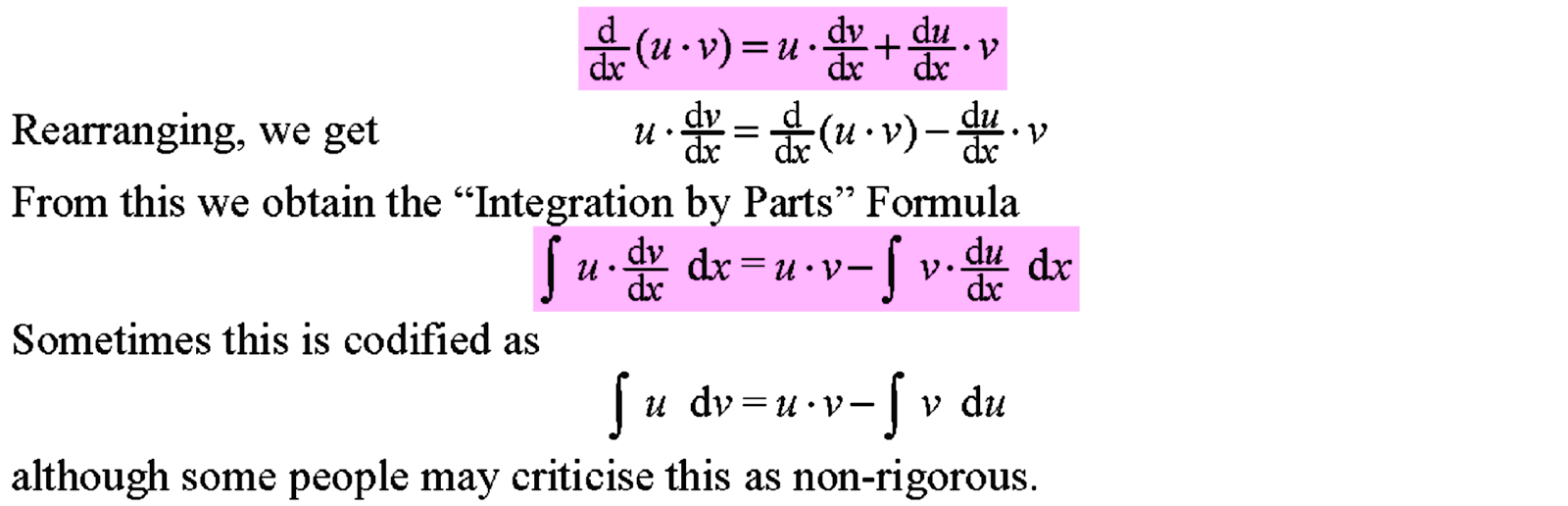
     How do we integrate a product of two functions e.g. find   ò x sin x dx ?   Unlike differentiation, there are not that many general rules (e.g. the Chain Rule, the Product Rule and the Quotient Rule) that we can use for integration.  However “Integration by parts” is similar to and can be obtained from the differentiation Product Rule


Applying Integration by Parts
     But how do we use the formula?  Before you do anything, analyse and classify the functions first.  You need to choose something for the  “u”  and  something for the “dv”  or  “dv/dx”.  For your choice of the “dv/dx” part, you can use the “d(etail)” heuristic as a guide.
     “e” is for exponential functions:      e.g. e2x, 3x.
     “t” is for trigonometric functions:   e.g. tan x, sin 3x, cos 2x.
     “a” is for algebraic functions:         e.g. 3x3, constants, 4xx2.
     “i” is for inverse functions:             e.g. sin-1 x, tann-1 5x.
     “l” is for logarithmic functions:      e.g. ln x, lg x, log2 x.
  
Here are some examples of choices for  “dv/dx”  and  “u” using the “d(etail)” heuristic.

Integral
Analysis
dv/dx
u
ò x sin x dx
x  is algebraic, sin x  is trigonometric,
t comes before a
sin x
x
ò e-x cos x dx
e-x  is exponential, cos x  is trigonometric,
e comes before t
e-x
cos x
ò x tan-1 x dx
x  is algebraic, tan-1 x  is inverse,
a comes before i
x
tan-1 x
ò ln x dx = ò (ln x)(1) dx
1  is algebraic, ln x  is logarithmic,
a comes before l
1
ln x

The above is actually equivalent to “liate” for the choice of  u, which is taught by many lecturers trained in American universities.  Once you have chosen  v,  the other part u  is automatically chosen,  and vice versa.  But personally, I think “d(etail)” is easier to remember: 
If you forget the details, just remember “d(etail)”!

I shall now illustrate the working of the first example with different styles of presentation.

Presentation 1 (for beginners – using “u” and “v” explicitly)


Presentation 2 (intermediate – using “pre-integration”)

With sufficient practice, the integration can be written down quickly as follows:-

Presentation 3 (advanced – for speed)
 
Remarks
     The “d(etail)” heuristic is a special one that is invented for Integration by Parts.  Like all heuristics, it is just a guideline or rule-of-thumb.  It works most of the time, but not all the time.  If you find that this does not work, you need to try different combinations of  u  and  dv.  The part chosen for “dv/dx” should be more easily integrable, or at least, you already know its integral.  After doing the by parts procedure, you should end up with an integral not more complicated than the original one.

Definite integrals
 

Suitable Levels
GCE ‘A’ Levels H2 Mathematics
* revision for IB Mathematics HL
* Advanced Placement (AP) Calculus BC
* other syllabuses that involve integration by parts
* any precocious or independent learner who loves calculus


Sunday, November 29, 2015

[AM_20151130IAXS] A Motif for the Absolutely Absolute

Problem


Introduction
     This question would pose a challenge for many students, although theoretically it is within reach of a good Additional Mathematics student (~ grade 10).  Graphs of both  sin x  and  cos x  are waves that oscillate up and down.  There are many pairs of vertical bars, indicating the absolute values or modulus, and these seem confusing.

Strategy
     Let us graph the functions  y = |cos x|   and  y = |sin x|.   Note that  ||sin x| – |cos x|| = ||cos x| – |sin x||.   The absolute difference of  |cos x|   and  |sin x|  is the difference between them ignoring the negative sign (if any) of the result.  And this is just the difference between the higher value and the lower value. 
Can you see any repeating patterns?  [H04]  Can you visualise the required area?  How many times is that of the basic pattern (known as “motif” in art)?  [H09, H10, H11]

Solution

Remarks
     Our total area is made up of four congruent pieces.  When  0 < x < p/4,  cos x  is higher than  sin x.  That allows us to strip away all the absolute signs and do the calculation.

H04. Look for pattern(s)
H09. Restate the problem in another way
H10. Simplify the problem
H11. Solve part of the problem

Suitable Levels
challenge for GCE ‘O’ Additional Mathematics  IB Mathematics SL HL
GCE ‘A’ Level H2 Mathematics  IB Mathematics HL
AP Calculus AB & BC
* University / College calculus
* other syllabuses that involve integration and area
* whoever is game for a challenge in integration


[H220151129IAAV] Integration for an Eclipsed Ellipse

Problem

Introduction
     Here we have a challenging H2 Mathematics question that tests students on the technique of substitution, finding area and volume of solid of revolution.  Note that the diagram is not drawn to scale and the line actually intersects the ellipse (oval shape) at the point (-2, 2).  Also the region  R  is the shaded area, but the label “R” is put outside of it.  Students should do their due diligence in ascertaining the intersection point themselves.

Solution
Remarks
     Since the word “exact” is not used in the instructions to part (iii), one can also use the Graphing Calculator to obtain the approximate answer  3.14  to 3 significant figures.  Part (iii) can also be done by another method of integration called the Shell Method, but this is not in the H2 syllabus.  Nevertheless, the student who uses it would not be penalised, unless explicitly forbidden in the rubric.
     The word “ellipse” means an oval shape, and is not to be confused with “eclipse” which means to occlude or hide (e.g. eclipse of the sun, eclipse of the moon).  By the way, the moon orbits around the earth in an ellipse and planets revolve around the sun in ellipses (ovals).
     Although not part of the syllabus, it may be advantageous to know that the area of a right ellipse is  pab,  where  a  and  b  are the semi-axes.  Imagine a circle of radius  a  being stretched by  b/a.  Then its area  pa2  will be multiplied by the same factor  b/a.  So this is not too difficult actually.  With the formula, one can verify one’s answer obtained by integration.

H02. Use a diagram / model
H04. Look for pattern(s)
H05. Work backwards        [ e.g. calculating new limits for substitution ]
H09. Restate the problem in another way
H10. Simplify the problem
H11. Solve part of the problem


Suitable Levels
GCE ‘A’ Level H2 Mathematics
IB Mathematics HL
* AP Calculus BC
* University / College calculus
* other syllabuses that involve applications of integration

* whoever is interested


Thursday, November 19, 2015

[U_Calculus_STKC58] Exploiting symmetry for a Complicated Integral

Question
     This problem appears as problem 58 from a Facebook group and it is set by Kunihiko Chikaya.  Ordinary integration problems are already challenging, but this one is tough on steroids. 

The Standard Approach

Solution 1


With this result, I realised that there is a short cut.  We can make use of symmetry.  Note that  sin(px) = sin x   and   cos(px) = - cos x.

Solution 2

H04. Look for pattern(s):         “onions”, exploit symmetry
H05. Work backwards
H09. Restate the problem in another way
H10. Simplify the problem
H11. Solve part of the problem

Suitable Levels
University / College Mathematics
challenge for ‘A’ Level H2 Mathematics
challenge for IB HL Mathematics
* other syllabuses that involve trigonometry and integration 


Thursday, October 29, 2015

[U_20151029ITCX] Roger Cotes’ Integral of the Reciprocal of x^n – 1

Question
 

Introduction
     The book VisualComplex Analysis by Tristan Needham recounts the story of RogerCotes who considered the above problem.  Without ostensibly using complex numbers, Cotes discovered a geometrical principle that helped to factorise the denominator  xn – 1,  and hence decompose the above integral.
     In this article, I am going to “cheat” by using complex numbers to split up the denominator.  The fact that the denominator splits completely into a product of simple linear factors makes it easy to decompose the integrand into partial fractions.  Once this is done, I can single out the one or two fractions with purely real linear denominators.  Then I can pair up the conjugate fractions to get fractions with real quadratic denominators.  In other words, I apply a divide-and-conquer strategy, splitting up a big problem into smaller problems (Heuristics!).  Then I collect all the partial answers together to form my final answer.


Solution

Remarks
     Note that I have only used real integration, not complex integration.  Complex numbers are used only to derive the various algebraic fractions.

H02. Use a diagram / model   (mentally: imagine roots of unity in a circle)
H04. Look for pattern(s)
H10. Simplify the problem
H11. Solve part of the problem
H13* Use Equation / write a Mathematical Sentence

Suitable Levels
University / college level calculus
high school students very strong and interested in calculus and complex numbers
* anybody who loves a challenging calculus problem and complex numbers