Product Rule for Integration?
How do we
integrate a product of two functions e.g. find ò x sin x dx ?
Unlike
differentiation, there are not that many general rules (e.g. the Chain Rule, the Product Rule and the Quotient Rule) that we can use for
integration. However “Integration by
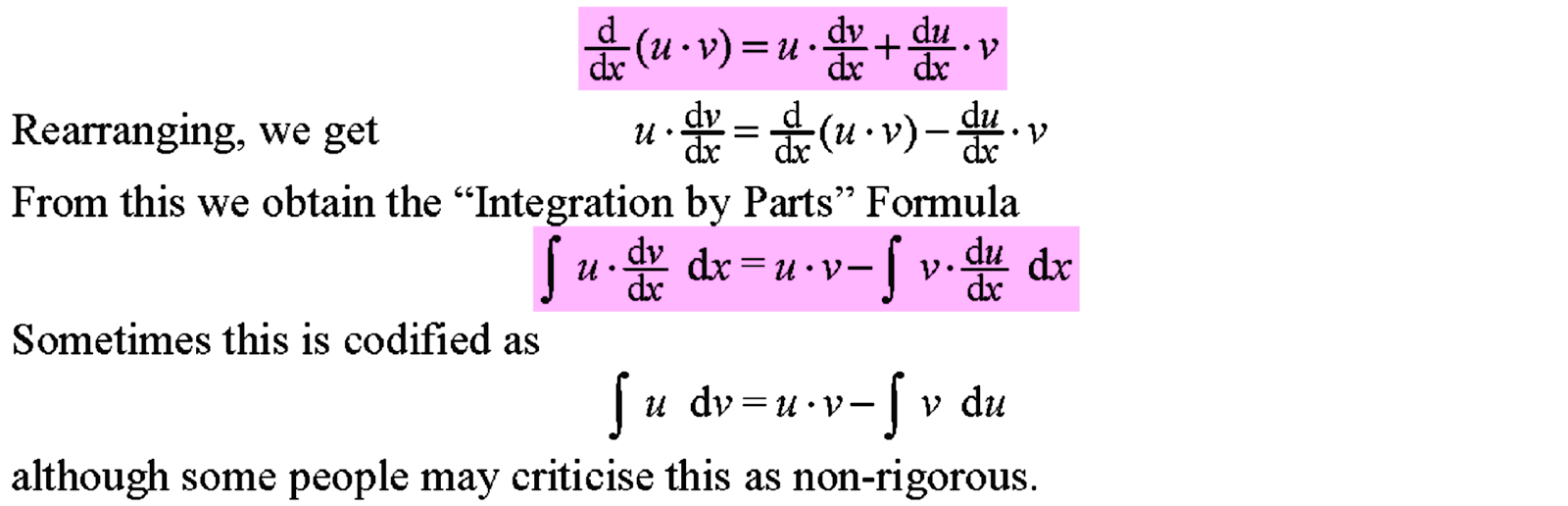
parts” is similar to and can be obtained from the differentiation Product Rule
Applying Integration by Parts
But how do we use the formula? Before you do anything, analyse and classify the
functions first. You need to choose
something for the “u” and something for the “dv” or “dv/dx”. For your choice of
the “dv/dx” part, you can use the “d(etail)” heuristic as a guide.
“e” is for exponential functions: e.g. e2x, 3x.
“t” is for trigonometric functions: e.g.
tan x, sin 3x, cos 2x.
“a” is for algebraic functions: e.g. 3x3,
constants, 4x – x2.
“i” is for inverse functions: e.g. sin-1 x, tann-1 5x.
“l” is for logarithmic functions: e.g. ln x, lg x, log2 x.
Here are some
examples of choices for “dv/dx” and “u” using the “d(etail)” heuristic.
Integral
|
Analysis
|
dv/dx
|
u
|
ò
x sin x dx
|
x is algebraic, sin x is trigonometric,
t comes before a
|
sin x
|
x
|
ò
e-x
cos x dx
|
e-x is exponential,
cos x is trigonometric,
e comes before t
|
e-x
|
cos x
|
ò
x tan-1 x dx
|
x is algebraic, tan-1 x
is inverse,
a comes before i
|
x
|
tan-1 x
|
ò
ln x
dx = ò (ln x)(1)
dx
|
1 is algebraic, ln x is logarithmic,
a comes before l
|
1
|
ln x
|
The above is actually equivalent to “liate” for the choice of u,
which is taught by many lecturers trained in American universities. Once you have chosen v, the other part u is automatically chosen, and vice versa. But personally, I think “d(etail)” is easier to remember:
If you forget
the details, just remember “d(etail)”!
|
I shall now
illustrate the working of the first example with different styles of
presentation.
Presentation 1 (for beginners – using “u” and “v” explicitly)
Presentation 2 (intermediate – using “pre-integration”)
With sufficient practice, the integration can be
written down quickly as follows:-
Presentation 3 (advanced – for speed)
Remarks
The
“d(etail)” heuristic is a special
one that is invented for Integration by Parts.
Like all heuristics, it is just a guideline or rule-of-thumb. It works most of the time, but not all the
time. If you find that this does not
work, you need to try different combinations of
u and dv.
The part chosen for “dv/dx” should be more easily integrable, or at least, you already
know its integral. After doing the by
parts procedure, you should end up with an integral not more complicated than
the original one.
Definite integrals
Suitable Levels
* other syllabuses that involve integration
by parts
* any precocious or independent learner who loves
calculus