Showing posts with label differentiation. Show all posts

Friday, October 12, 2018

[STEP3_2018_Q2] Sequence of Functions & Mathematical Induction

     This is a challenging problem on a sequence of functions, appearing as a Sixth Term Examination Papers (STEP) question.  STEP is the entrance exam for University of Cambridge and the University of Warwick undergraduate mathematics.  Some colleges and university departments may also require STEP.
     The student does not need to know that the question involves a Rodrigues type of formula.  However great facility in symbolic manipulation including algebra and calculus is needed, as this is what would be expected of students in a rigorous course involving mathematics or a related discipline.
     The first part is done via Differentiation using the Product Rule and the Chain Rule.
     For the mathematical induction proof in part (ii), the following is a rather standard way to begin.  You should do this even if you do not feel confident about the proof.  Just write it down, and worry later.  Say something like “RTP” (required to prove) or “to be proven” so as not to give the impression that you are making unproven assertions or making circular arguments, like what modern journalists and political activists are prone to do.

     The starting case is usually easier to handle.  Just follow your nose and differentiate using the Product Rule and the Chain Rule with  n = 1.
      The next part, the induction step, is the most challenging part.  The trick is to be clear about what is required and be observant.  There are no derivatives in the final required expression, and yet you should know that the earlier part of the question serves as a hint that you must use derivatives.  Using the induction hypothesis [IH], we end up with an expression that has two derivatives, which is a pain to do by hand.  So we repeatedly make use of [1] to convert back to some expression involving the function sequence, but not involving derivatives.  After some cancellation and simplification we finally complete the step.
     The following is the standard type of conclusion for mathematical induction proofs.  Just remember to write it in and earn the marks allocated.
     The last part is again challenging.  The key to solving it is to observe that  ‘x’  does not appear explicitly in the desired final expression.  So we proceed to try to eliminate the term that contains  ‘x’.  Examining the LHS would suggest the types of terms that we need formulas for, and upon subtraction, will kill off the term that contains  ‘x’.

     Ta da!  Done finally!

     To recap:  the strategies used to solve this question is observation, anticipation (know what you want at the ‘end of the rainbow’) and elimination (get rid of the unwanted term).  Needless to say, you would also need to be thoroughly familar with the standard ‘A’ level Further Maths stuff involving differentiation using the Product Rule and the Chain Rule, sequences and mathematical induction.
     

You are invited to join my group Effective and Elegant Mathematics on Facebook.

This article is suitable for
* GCE ‘A’ Level Further Mathematics
* Students doing STEP and/or students applying to study undergraduate mathematics in Cambridge / Oxford / Warwick
* other syllabuses calculus and sequences
* any learner who is interested

Monday, January 25, 2016

[AM_20160125DAHT] Horizontal Tangents via Quadratic Discriminants

Problem

Introduction
     This is a Additional Mathematics textbook problem.  This question is of an intermediate level of difficulty.  The general method is by differentiation.  The equation of the curve happens to be capable of being put into a quadratic equation in  x.  Hence we can also use the theory of quadratic discriminants.  I present both methods of solution.

Method 1 (Using differential calculus)


Method 2 (Using quadratic discriminants)

Heuristics Used
H04. Look for pattern(s)
H05. Work backwards
H09. Restate the problem in another way
H11. Solve part of the problem
H12* Think of a related problem
H13* Use Equation / write a Mathematical Sentence

Suitable Levels
* GCE ‘O’ Level Additional Mathematics
* other syllabuses that involve differentiation or quadratic discriminants
* any independent learner who is interested


Wednesday, December 23, 2015

[AM_20151223DATP] A Horizontal Tangent and a Faux Asymptote

Problem / Question
 

Solution 1

Solution 2  (not using differentiation)

Remarks
     This problem just happened to be put as an exercise in a textbook under the applications of differentiation.  But who says one must use differentiation?  Once again, there are at least two ways to solve a mathematical problem.  In this instance, it happened that the equation of the curve can be put into a quadratic form that is amenable to analysis by the discriminant.  Mathematics is about mental flexibility and creativity, actually.
     An asymptote is a straight line that the curve goes near to (but does not touch), as  x  gets large or gets very negative.  The book’s use of the phrase  “tends towards the line  l” may be wrong or imprecise.  Technically, the line  l  is not an  asymptote, because if you analyse or plot the graph, the gap between the curve and the line does not really get closer and closer.  However, the ratio of  y  over  x  gets nearer and nearer to  -1  and the gradient of the curve also gets nearer and nearer to  -1.  What really happens is: as  x  increases, eventually the curve becomes almost parallel to the line, but does not go near it.


H02. Use a diagram / model
H04. Look for pattern(s)
H05. Work backwards
H09. Restate the problem in another way
H10. Simplify the problem
H11. Solve part of the problem
H13* Use Equation / write a Mathematical Sentence

Suitable Levels
* GCE ‘O’ Level Additional Mathematics,  “IP Mathematics”
* revision for  GCE ‘A’ Levels H2 Mathematics
* revision for IB Mathematics HL & SL
* revision for  Advanced Placement (AP) Calculus AB & BC
* other syllabuses that involve differentiation and/or quadratic functions
* any precocious or independent learner who wants to learn


Wednesday, December 2, 2015

[H2_Expository] Integration by Parts and the “d(etail)” Heuristic


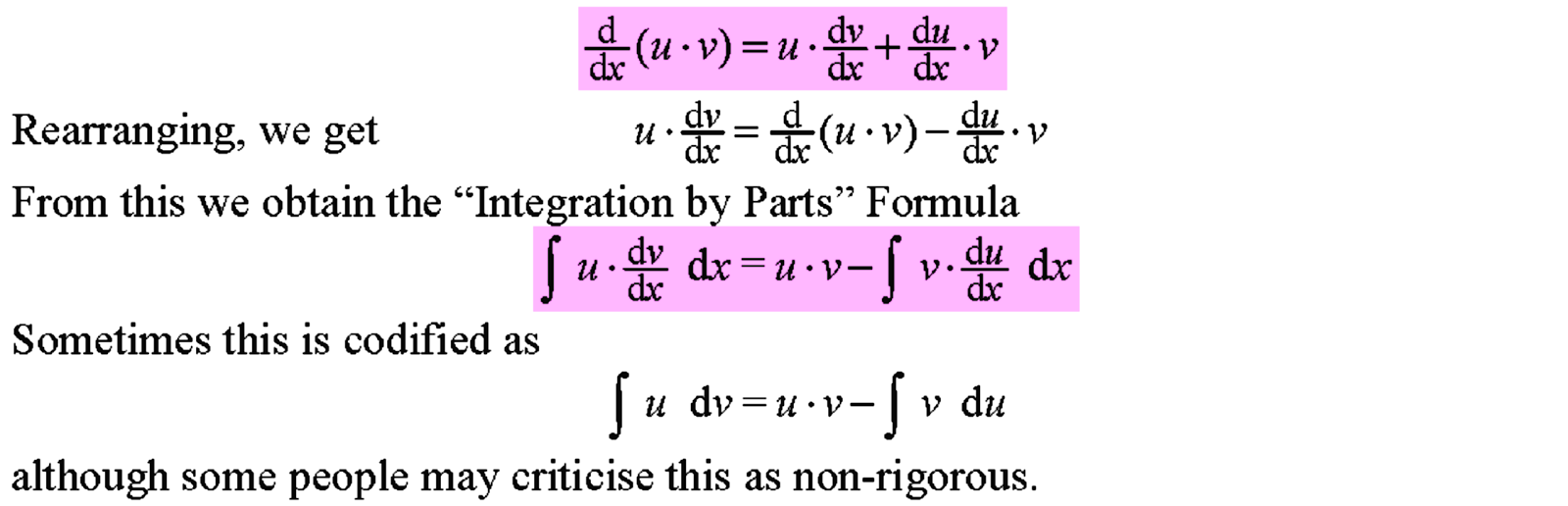
Product Rule for Integration?
     How do we integrate a product of two functions e.g. find   Ã² x sin x dx ?   Unlike differentiation, there are not that many general rules (e.g. the Chain Rule, the Product Rule and the Quotient Rule) that we can use for integration.  However “Integration by parts” is similar to and can be obtained from the differentiation Product Rule


Applying Integration by Parts
     But how do we use the formula?  Before you do anything, analyse and classify the functions first.  You need to choose something for the  “u”  and  something for the “dv”  or  “dv/dx”.  For your choice of the “dv/dx” part, you can use the “d(etail)” heuristic as a guide.
     “e” is for exponential functions:      e.g. e2x, 3x.
     “t” is for trigonometric functions:   e.g. tan x, sin 3x, cos 2x.
     “a” is for algebraic functions:         e.g. 3x3, constants, 4x – x2.
     “i” is for inverse functions:             e.g. sin-1 x, tann-1 5x.
     “l” is for logarithmic functions:      e.g. ln x, lg x, log2 x.
  
Here are some examples of choices for  “dv/dx”  and  “u” using the “d(etail)” heuristic.

Integral
Analysis
dv/dx
u
ò x sin x dx
x  is algebraic, sin x  is trigonometric,
t comes before a
sin x
x
ò e-x cos x dx
e-x  is exponential, cos x  is trigonometric,
e comes before t
e-x
cos x
ò x tan-1 x dx
x  is algebraic, tan-1 x  is inverse,
a comes before i
x
tan-1 x
ò ln x dx = ò (ln x)(1) dx
1  is algebraic, ln x  is logarithmic,
a comes before l
1
ln x

The above is actually equivalent to “liate” for the choice of  u, which is taught by many lecturers trained in American universities.  Once you have chosen  v,  the other part u  is automatically chosen,  and vice versa.  But personally, I think “d(etail)” is easier to remember: 
If you forget the details, just remember “d(etail)”!

I shall now illustrate the working of the first example with different styles of presentation.

Presentation 1 (for beginners – using “u” and “v” explicitly)


Presentation 2 (intermediate – using “pre-integration”)

With sufficient practice, the integration can be written down quickly as follows:-

Presentation 3 (advanced – for speed)
 
Remarks
     The “d(etail)” heuristic is a special one that is invented for Integration by Parts.  Like all heuristics, it is just a guideline or rule-of-thumb.  It works most of the time, but not all the time.  If you find that this does not work, you need to try different combinations of  u  and  dv.  The part chosen for “dv/dx” should be more easily integrable, or at least, you already know its integral.  After doing the by parts procedure, you should end up with an integral not more complicated than the original one.

Definite integrals
 

Suitable Levels
* GCE ‘A’ Levels H2 Mathematics
* revision for IB Mathematics HL
* Advanced Placement (AP) Calculus BC
* other syllabuses that involve integration by parts
* any precocious or independent learner who loves calculus


Tuesday, December 1, 2015

[H2_Expository] Derivative of the Arcsecant function

Introduction
     This article explains how to differentiate, i.e. find the derivative of, the arcsecant function, which is seldom discussed in class.  If you look at the various syllabus outlines, sometimes they do not explicitly mention or imply the arcsecant, neither do they explicitly exclude this.  The important thing is: we should be able to figure it out from our basic knowledge, which is the whole point of mathematics.  The people who talk about and focus on mathematics syllabus content as if it is the only or most important thing are missing the point of mathematics education, and there are a plenty of these idiots around.  Do not follow them.
     The arcsecant, written as arcsec or sec-1, is also known as the inverse secant function.  So arcsecant means that, given the value of a secant function, you want “the” angle whose secant is that given value.  The problem is there are many possible values.  Look at the graph below.


Defining the Inverse of the secant properly
     On the graph, a horizontal line can pass through (infinitely) many points.  Like any periodic trigonometric function, the secant function is not a one-to-one (a.k.a. “injective” or  “one-one”) function.  As such, it is not invertible.  However, we can restrict the function so that its domain is  [0, p] \ { p/2 }.  This is highlighted in yellow on the graph.
     Remember that sec x = 1/cos x.  Basically we follow the principal values  [0, p]  of the arccosine function   except  p/2  where the cosine is zero and its reciprocal the secant is undefined.       With this restriction on the domain, we get a one-one secant function, with range (-¥, -1] È [1, +¥).  We can now define the inverse function, and its graph is obtained by reflecting the above graph along the mirror line  y = x.  We get this:-

     Observe that in the yellow regions in both graphs, the gradients at the points are non-negative.  We have chosen the domain of the secant function, which is the same as the range of the arcsecant function, such that the derivatives will be non-negative.

Deriving the Derivative (refer to the“Onion” Method for differentiation)


Remarks
     Do not confuse  arccos y   with  (cos y)-1.  They are not mean the same thing.
     In case you are wondering, the prefix “arc-” means the angle, which (if you use radians) is literally the same as the arc-length when the radius equals to  1.  In symbols, s = rq  with r = 1 means  s = q.  Although the term can be used with degrees or other units, when doing advanced mathematics like calculus, we would usually be using radians anyway. 

Suitable Levels
* GCE ‘A’ Levels H2 Mathematics
* International Baccalaureate (IB) HL Mathematics
* Advanced Placement (AP) Calculus AB & BC
* University / College calculus
* other syllabuses that involve differentiation
* any learner interested in calculus


Friday, November 27, 2015

[AM_20151127DTCR] The “Onion” Method for Differentiation

Question

Introduction
     The differentiation of the secant function is not taught directly as part of the Additional Mathematics syllabus.  It can be derived from known facts.  I first show the standard application of the (extended) Chain Rule for novices, and then show a more effective way of applying the chain rule, which I called the “Onion Method”.  This looks like peeling onions or unpacking Matryoshka dolls (“Russian dolls”). 

Reminders

Solution 1  (for beginners)

Solution 2  (a more expedient way)


Final Remarks
     When we peel onions, we peel from the outer layer inwards.  Likewise, when we have a composite function, we differentiate from the outer layer first, and then work to the inner layers.  Every time we differentiate a layer, we write down the changed layer and then copy and paste everything within that layer.  With regular practice, this should become second nature.
     For another example of the “onion”, take a look at the derivative of the arcsecant function.

H04. Look for pattern(s)
H05. Work backwards
H09. Restate the problem in another way
H10. Simplify the problem
H11. Solve part of the problem
H13* Use Equation / write a Mathematical Sentence


Suitable Levels
* GCE ‘O’ Level Additional Mathematics
* GCE ‘A’ Level H1 Mathematics
* GCE ‘A’ Level H2 Mathematics (revision)
* International Baccalaureate SL & HL Mathematics
* AP Calculus AB & BC
* other syllabuses that calculus
* anyone who loves to learn!


[AM_20151127DF2D] Differentiation with Chunking and Elimination

Question

Introduction
     Although this looks like a differential equation question, the student is not required to solve the differential equation.  The requirement is just to derive the equation.  This would be a challenging question for secondary 4 (~ grade 10) students taking Additional Mathematics or their counterparts in Integrated Programme schools.

Strategy
     One way to do this is to differentiate the given equation once and again and just verify the equation by substitution.  The problem is that when we repeatedly apply the Product rule
the terms tend to sprawl.  A way to keep things neat is to try to recognise chunks and also use elimination.

Solution

Remarks
     After differentiating once, we notice that  10xe2x   is twice of  5xe2x,  and this allows the simplification in [1].  The second differentiation yields  10e2x   which, we notice, is twice of  5e2x.  We can get rid of that term.   Multiplying equation [1] by 2 gives  10e2x  in equation [3],  which matches nicely with the same term in  [2].  So we can eliminate that term via elimination.  After that, we just need to rearrange things to get the final equation.

H04. Look for pattern(s)
H05. Work backwards
H10. Simplify the problem
H11. Solve part of the problem
H13* Use Equation / write a Mathematical Sentence


Suitable Levels
* GCE ‘O’ Level Additional Mathematics, “Integrated Programme Mathematics”
* GCE ‘A’ Levels H2 Mathematics (revision)
* AP Calculus AB / BC (revision)
* University / College calculus (revision)
* other syllabuses that involve differentiation
* any learner interested in calculus


Sunday, June 28, 2015

[AM_20150620DFFPPR] Differentiation of Powers from First Principles

Question
Introduction
     This question was posted to a Facebook forum for Secondary School and Junior College mathematics (the equivalent of grade 7 and above).  Most students, except a few enthusiastic ones or maybe some from “integrated programme” schools, will not bother with differentiation from first principles.  However, mathematical formulas are true because mathematicians took the trouble to critically analyse them and show that they always work, not because they are found in the textbook, nor because the teacher says so.

Solution


Remarks
     The answer to the original problem just falls out by letting  p = 17  and  q = 19.
     Some people suggested using Binomial Expansion for rational powers.  I feel that this is not from first principles, since Binomial Expansion relies on differentiation, which relies on first principles.

Suitable Levels
* GCE ‘O’ Level Additional Mathematics
* college level calculus
* AP Calculus
* other syllabuses that involve differentiation from first principles, or anyone who is interested