Showing posts with label calculus. Show all posts

Thursday, November 3, 2016

[Enrich20161103NRP] The Napkin Ring Problem

Problem

     Two rings are made by drilling a cylindrical hole through a small sphere and a hole through the large sphere, such that the resulting rings have the same height (2h).
     Which ring has the larger volume of remaining material?

Solution
     The answer is: both rings have the same volume.  How can we know?
     There is a way to show this using integration.  But calculus is not necessary.

     Let  r  be the radius of any chosen sphere and let  a  be the radius of the cylindrical hole.  By Pythagoras’ Theorem,  h² = r² – a².  Consider a cross-section of the ring sliced a distance  x  from the centre of the sphere, perpendicular to the axis of the cylindrical hole.  The outer radius of this cross section is the square root of  r² – x².  Hence the area of the material in the cross-section is
               p [(r² – x²) – a²]  =  p (r² – a² – x²)  =  p (h² – x²)
Note that  r  does not appear in the formula.  That means the cross-section does not depend on  r.  A bigger (or smaller) sphere would have the same cross-sectional area for each distance  x  away from the centre.  By Cavalieri'sPrinciple, the other sphere will have the same volume!
     By the way what is this volume?  It is the same as that of a sphere without hole  i.e.  where  a = 0  and  r = h.  This works out to be  4/3 p h³,  where  h  is half the height of the ring.

H02. Use a diagram / model
H09. Restate the problem in another way
H11. Solve part of the problem
H13* Use Equation / write a Mathematical Sentence

Suitable Levels
* GCE ‘A’ Levels H2 Mathematics (Number patterns, with algebra)
* revision for IB Mathematics HL & SL
* Advanced Placement (AP) Calculus AB & BC
* University / College Calculus
* other syllabuses that involve volumes and Pythagoras’ Theorem
* any learner who is interested


Sunday, December 20, 2015

[AP_Calculus_IGSB] Integrating an Exponential with Square Root

Problem

Introduction
     Here is an integration problem that has no clues as to what to do with it.  Hmmm ... the integrand (3 to the power of square root something) does not look like it can be simplified.  [H09, H10]  How about a substitution?  [H12]  But what substitution?  Usually, we substitute the “ugliest” part of the integrand.  What constitutes the “ugliest” requires experience and observation.  In this case, the square root expression looks pretty nasty.  But how do we even integrate  3  to the power of something?

How to Integrate the Exponential


Solution

Comment
     In this problem, the original variable of integration is  x.  When doing substitutions, it is usually easier to make  x  the subject, and then replace the  “dx” with its equivalent.  After the substitution [H11], we integrate by parts and then substitute back to express everything in terms of  x.

H04. Look for pattern(s)        [look for the “ugliest” part]
H05. Work backwards
H09. Restate the problem in another way
H10. Simplify the problem
H11. Solve part of the problem
H12* Think of a related problem

Suitable Levels
* GCE ‘A’ Levels H2 Mathematics (challenge)
* IB Mathematics HL (challenge)
* Advanced Placement (AP) Calculus AB & BC
* University / College calculus
* other syllabuses that involve integration
* any precocious or independent learner who is interested


Wednesday, December 2, 2015

[H2_Expository] Integration by Parts and the “d(etail)” Heuristic


Product Rule for Integration?
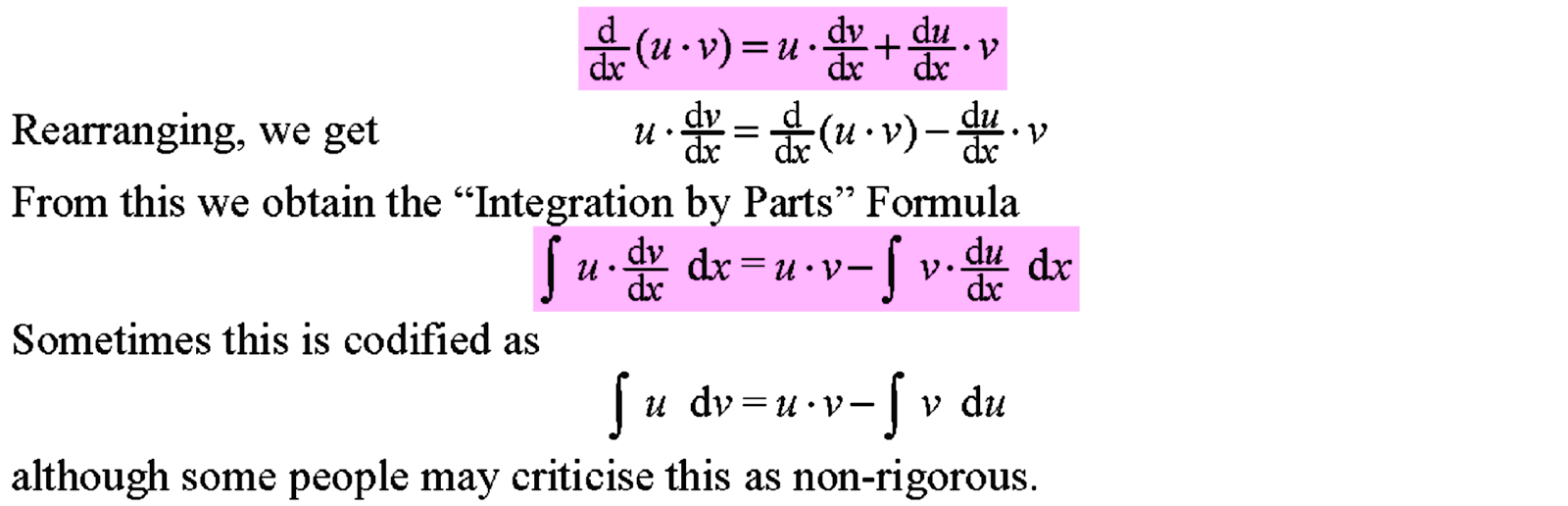
     How do we integrate a product of two functions e.g. find   ò x sin x dx ?   Unlike differentiation, there are not that many general rules (e.g. the Chain Rule, the Product Rule and the Quotient Rule) that we can use for integration.  However “Integration by parts” is similar to and can be obtained from the differentiation Product Rule


Applying Integration by Parts
     But how do we use the formula?  Before you do anything, analyse and classify the functions first.  You need to choose something for the  “u”  and  something for the “dv”  or  “dv/dx”.  For your choice of the “dv/dx” part, you can use the “d(etail)” heuristic as a guide.
     “e” is for exponential functions:      e.g. e2x, 3x.
     “t” is for trigonometric functions:   e.g. tan x, sin 3x, cos 2x.
     “a” is for algebraic functions:         e.g. 3x3, constants, 4x – x2.
     “i” is for inverse functions:             e.g. sin-1 x, tann-1 5x.
     “l” is for logarithmic functions:      e.g. ln x, lg x, log2 x.
  
Here are some examples of choices for  “dv/dx”  and  “u” using the “d(etail)” heuristic.

Integral
Analysis
dv/dx
u
ò x sin x dx
x  is algebraic, sin x  is trigonometric,
t comes before a
sin x
x
ò e-x cos x dx
e-x  is exponential, cos x  is trigonometric,
e comes before t
e-x
cos x
ò x tan-1 x dx
x  is algebraic, tan-1 x  is inverse,
a comes before i
x
tan-1 x
ò ln x dx = ò (ln x)(1) dx
1  is algebraic, ln x  is logarithmic,
a comes before l
1
ln x

The above is actually equivalent to “liate” for the choice of  u, which is taught by many lecturers trained in American universities.  Once you have chosen  v,  the other part u  is automatically chosen,  and vice versa.  But personally, I think “d(etail)” is easier to remember: 
If you forget the details, just remember “d(etail)”!

I shall now illustrate the working of the first example with different styles of presentation.

Presentation 1 (for beginners – using “u” and “v” explicitly)


Presentation 2 (intermediate – using “pre-integration”)

With sufficient practice, the integration can be written down quickly as follows:-

Presentation 3 (advanced – for speed)
 
Remarks
     The “d(etail)” heuristic is a special one that is invented for Integration by Parts.  Like all heuristics, it is just a guideline or rule-of-thumb.  It works most of the time, but not all the time.  If you find that this does not work, you need to try different combinations of  u  and  dv.  The part chosen for “dv/dx” should be more easily integrable, or at least, you already know its integral.  After doing the by parts procedure, you should end up with an integral not more complicated than the original one.

Definite integrals
 

Suitable Levels
* GCE ‘A’ Levels H2 Mathematics
* revision for IB Mathematics HL
* Advanced Placement (AP) Calculus BC
* other syllabuses that involve integration by parts
* any precocious or independent learner who loves calculus


Sunday, November 29, 2015

[H220151129IAAV] Integration for an Eclipsed Ellipse

Problem

Introduction
     Here we have a challenging H2 Mathematics question that tests students on the technique of substitution, finding area and volume of solid of revolution.  Note that the diagram is not drawn to scale and the line actually intersects the ellipse (oval shape) at the point (-2, 2).  Also the region  R  is the shaded area, but the label “R” is put outside of it.  Students should do their due diligence in ascertaining the intersection point themselves.

Solution
Remarks
     Since the word “exact” is not used in the instructions to part (iii), one can also use the Graphing Calculator to obtain the approximate answer  3.14  to 3 significant figures.  Part (iii) can also be done by another method of integration called the Shell Method, but this is not in the H2 syllabus.  Nevertheless, the student who uses it would not be penalised, unless explicitly forbidden in the rubric.
     The word “ellipse” means an oval shape, and is not to be confused with “eclipse” which means to occlude or hide (e.g. eclipse of the sun, eclipse of the moon).  By the way, the moon orbits around the earth in an ellipse and planets revolve around the sun in ellipses (ovals).
     Although not part of the syllabus, it may be advantageous to know that the area of a right ellipse is  pab,  where  a  and  b  are the semi-axes.  Imagine a circle of radius  a  being stretched by  b/a.  Then its area  pa2  will be multiplied by the same factor  b/a.  So this is not too difficult actually.  With the formula, one can verify one’s answer obtained by integration.

H02. Use a diagram / model
H04. Look for pattern(s)
H05. Work backwards        [ e.g. calculating new limits for substitution ]
H09. Restate the problem in another way
H10. Simplify the problem
H11. Solve part of the problem


Suitable Levels
* GCE ‘A’ Level H2 Mathematics
* IB Mathematics HL
* AP Calculus BC
* University / College calculus
* other syllabuses that involve applications of integration

* whoever is interested


Friday, November 27, 2015

[AM_20151127DF2D] Differentiation with Chunking and Elimination

Question

Introduction
     Although this looks like a differential equation question, the student is not required to solve the differential equation.  The requirement is just to derive the equation.  This would be a challenging question for secondary 4 (~ grade 10) students taking Additional Mathematics or their counterparts in Integrated Programme schools.

Strategy
     One way to do this is to differentiate the given equation once and again and just verify the equation by substitution.  The problem is that when we repeatedly apply the Product rule
the terms tend to sprawl.  A way to keep things neat is to try to recognise chunks and also use elimination.

Solution

Remarks
     After differentiating once, we notice that  10xe2x   is twice of  5xe2x,  and this allows the simplification in [1].  The second differentiation yields  10e2x   which, we notice, is twice of  5e2x.  We can get rid of that term.   Multiplying equation [1] by 2 gives  10e2x  in equation [3],  which matches nicely with the same term in  [2].  So we can eliminate that term via elimination.  After that, we just need to rearrange things to get the final equation.

H04. Look for pattern(s)
H05. Work backwards
H10. Simplify the problem
H11. Solve part of the problem
H13* Use Equation / write a Mathematical Sentence


Suitable Levels
* GCE ‘O’ Level Additional Mathematics, “Integrated Programme Mathematics”
* GCE ‘A’ Levels H2 Mathematics (revision)
* AP Calculus AB / BC (revision)
* University / College calculus (revision)
* other syllabuses that involve differentiation
* any learner interested in calculus


Thursday, October 29, 2015

[U_20151029ITCX] Roger Cotes’ Integral of the Reciprocal of x^n – 1

Question
 

Introduction
     The book VisualComplex Analysis by Tristan Needham recounts the story of RogerCotes who considered the above problem.  Without ostensibly using complex numbers, Cotes discovered a geometrical principle that helped to factorise the denominator  xn – 1,  and hence decompose the above integral.
     In this article, I am going to “cheat” by using complex numbers to split up the denominator.  The fact that the denominator splits completely into a product of simple linear factors makes it easy to decompose the integrand into partial fractions.  Once this is done, I can single out the one or two fractions with purely real linear denominators.  Then I can pair up the conjugate fractions to get fractions with real quadratic denominators.  In other words, I apply a divide-and-conquer strategy, splitting up a big problem into smaller problems (Heuristics!).  Then I collect all the partial answers together to form my final answer.


Solution

Remarks
     Note that I have only used real integration, not complex integration.  Complex numbers are used only to derive the various algebraic fractions.

H02. Use a diagram / model   (mentally: imagine roots of unity in a circle)
H04. Look for pattern(s)
H10. Simplify the problem
H11. Solve part of the problem
H13* Use Equation / write a Mathematical Sentence

Suitable Levels
* University / college level calculus
* high school students very strong and interested in calculus and complex numbers
* anybody who loves a challenging calculus problem and complex numbers


Wednesday, May 20, 2015

[U_Calculus_20150520DCPL] Different Coordinate Systems, Same Lengths

Question

Introduction
     I got this question from a student who as studying AP Calculus under a school teacher who went beyond the syllabus.  If we try to do this question directly, it will be a tedious mess without any insight.  Is calculus just a mindless torture?  Is there a better way to look at the problem?

Solution

Remarks
     Observe that both the LHS and the RHS are squares of lengths of the vector gradient  Ñw  of  w  in their respective coordinate systems (polar for LHS and rectangular for RHS).  The key insight is that the Jacobian-like matrix  J  represents a rotation, which common sense tells us preserves lengths.  So it is not surprising that the LHS and RHS are equal.  This is one of the “evidences” that the vector gradient is a concept that transcends coordinate systems, and represents something “real and physical”.  Indeed the gradient  Ñw  is the vector that represents the change of  w  per unit distance in its direction of maxium increase.

H04. Look for pattern(s)
H09. Restate the problem in another way
H10. Simplify the problem
H12* Think of a related problem
H13* Use Equation / write a Mathematical Sentence

Suitable Levels
* University Level Mathematics  (Calculus, Vector Calculus)
* AP Calculus students who wish to stretch themselves / are being stretched
* other syllabuses that involve calculus and coordinate systems