Showing posts with label sequences. Show all posts

Friday, October 12, 2018

[STEP3_2018_Q2] Sequence of Functions & Mathematical Induction

     This is a challenging problem on a sequence of functions, appearing as a Sixth Term Examination Papers (STEP) question.  STEP is the entrance exam for University of Cambridge and the University of Warwick undergraduate mathematics.  Some colleges and university departments may also require STEP.
     The student does not need to know that the question involves a Rodrigues type of formula.  However great facility in symbolic manipulation including algebra and calculus is needed, as this is what would be expected of students in a rigorous course involving mathematics or a related discipline.
     The first part is done via Differentiation using the Product Rule and the Chain Rule.
     For the mathematical induction proof in part (ii), the following is a rather standard way to begin.  You should do this even if you do not feel confident about the proof.  Just write it down, and worry later.  Say something like “RTP” (required to prove) or “to be proven” so as not to give the impression that you are making unproven assertions or making circular arguments, like what modern journalists and political activists are prone to do.

     The starting case is usually easier to handle.  Just follow your nose and differentiate using the Product Rule and the Chain Rule with  n = 1.
      The next part, the induction step, is the most challenging part.  The trick is to be clear about what is required and be observant.  There are no derivatives in the final required expression, and yet you should know that the earlier part of the question serves as a hint that you must use derivatives.  Using the induction hypothesis [IH], we end up with an expression that has two derivatives, which is a pain to do by hand.  So we repeatedly make use of [1] to convert back to some expression involving the function sequence, but not involving derivatives.  After some cancellation and simplification we finally complete the step.
     The following is the standard type of conclusion for mathematical induction proofs.  Just remember to write it in and earn the marks allocated.
     The last part is again challenging.  The key to solving it is to observe that  x  does not appear explicitly in the desired final expression.  So we proceed to try to eliminate the term that contains  x’.  Examining the LHS would suggest the types of terms that we need formulas for, and upon subtraction, will kill off the term that contains  x’.

     Ta da!  Done finally!

     To recap:  the strategies used to solve this question is observation, anticipation (know what you want at the ‘end of the rainbow’) and elimination (get rid of the unwanted term).  Needless to say, you would also need to be thoroughly familar with the standard ‘A’ level Further Maths stuff involving differentiation using the Product Rule and the Chain Rule, sequences and mathematical induction.
     

You are invited to join my group Effective and Elegant Mathematics on Facebook.

This article is suitable for
GCE ‘A’ Level Further Mathematics
Students doing STEP and/or students applying to study undergraduate mathematics in Cambridge / Oxford / Warwick
* other syllabuses calculus and sequences
* any learner who is interested

Saturday, December 26, 2015

[S1_20151226NPSW] Finding the General Term of a Sequence (2)

Problem

Introduction
     The above was discussed in this previous article.  The earlier parts of the problem are easy.  The major sticking point is finding the formula for  Sn.  We solved that using factorisation and observation, which I feel is the best way.  But what if you cannot do that and you are desperate (for example, in an exam or test)?
     This article introduces Newton’s Method, which can be used as a back-up method, even though it is not in the regular syllabus.

Solution (Newton’s Method)
 

Remark
     Note that number sequences in “IQ tests” (with no problem contexts) have been debunked.  In our case here, the numbers do have a certain regularity arising from the pattern of dots.  In fact this is an arithmetic progression.  What we are calculating is the sum of an arithmetic progression.  However, Newton’s Method extends beyond arithmetic progressions.

Suitable Levels
Lower School Mathematics
GCE ‘O’ Level “Elementary” Mathematics (revision)
GCE ‘A’ Levels H2 Mathematics (revision)
* other syllabuses that involve number patterns and sequences
* any precocious or independent learner who is interested


[S1_20151226NPGT] Finding the General Term of a Sequence (1)

Problem

Introduction
     This is a typical Secondary 1 type of problem involving number patterns.  Students are usually able to see the link between successive terms, but the general formula seems to be a challenge for most.

Strategy
     In case this is not obvious, every time you go to the next diagram, you add four dots on the outside.  So you can fill in the table very easily.  For diagram 5, there would be  19  dots and the total number of dots up to diagram  5  would be  55.

     What is the number of dots for diagram  1 000  or any number  n  for that matter?  Now, some students may have a problem predicting beyond the first few numbers.  What we need is a expression or formula that predicts the number of dots given the diagram number  n.  You know that the sequence  3,  7,  11,  15,  ...  follow a pattern where you keep adding  4.  Have you encountered a sequence in which  4  is added each time?  Yes!  It is the 4 times table.  Suppose we have the 4 times table.  [H08]   Let us do a comparison between that and  Dn.
diagram #
1
2
3
4
5
...
n
4 times table
4
8
12
16
20
...
4n
Dn
3
7
11
15
19
...
?

The numbers in  Dn  are always one less than those in the  4  times table.  So  Dn = 4n – 1.

Solution

n
number of dots for the  nth  diagrams
Dn
Sum of number of dots for the first  n  diagrams
Sn
1
3
3
2
7
10
3
11
21
4
15
36
5
19
55

     Dn = 4n – 1
     Sn  = n(2n + 1)   ©

Commentary
     How can we get the formula for  Sn?  We can do so by trying to factorise the numbers [H09], and then look for pattern.  [H04, H05]
           3 = 1×3   = 1×(2×1+1)
         10 = 2×5   = 2×(2×2+1)
         21 = 3×7   = 3×(2×3+1)
         36 = 4×9   = 4×(2×4+1)
         55 = 5×11 = 5×(2×5+1)
         ...
                      Sn = n(2n + 1)   ©  bingo!

But what if you have poor observational powers and if you are desperate?  There is a secret weapon to handle this!  Please refer to this article.

H04. Look for pattern(s)
H05. Work backwards
H08. Make suppositions
H09. Restate the problem in another way


Suitable Levels
Primary School Mathematics (challenge)
Lower Secondary Mathematics (Sec 1 ~ grade 7)
GCE ‘O’ Level “Elementary” Mathematics (revision)
* other syllabuses that involve number patterns and algebra
* any precocious or independent learner who loves number patterns

Monday, November 23, 2015

[H2_20151123APGP] Factor Theorem with Arithmetic and Geometric Progression

Question

Introduction
     This question tests students on their knowledge of arithmetic and geometric series.  They should also be familiar with Factor Theorem and methods of dealing with polynomials.  Once parts (i) and (ii) are solved, part (iii) is quite straightforward, provided that the student remembers how to deal with surds.

Review of Important Facts

Solution


H04. Look for pattern(s)
H05. Work backwards
H10. Simplify the problem
H11. Solve part of the problem
H13* Use Equation / write a Mathematical Sentence


Suitable Levels
GCE ‘A’ Level H2 Mathematics
IB HL Mathematics
* other syllabuses that series and Factor Theorem


Tuesday, June 9, 2015

[Pri20150402PTSMAP] A Staircase with Higher Steps

Question


Introduction
     This pertains to the sum of consecutive numbers with constant skips.  I set this question
to illustrate the heuristic of looking for patterns [H04].  It is similar to this question, except that now the numbers jump or skip by  2  instead of just   1.  The more knowledgeable reader will doubtless recognise this to be an arithmetic progression.  The challenge now is how can a primary school pupil do it without having learnt about any more advanced mathematics or algebra, relying purely on pattern recognition.

Solution
     As in the previous solution, imagine the sum as a series of vertical bars.  The numbers all jump by  2  this time.  Because the jump amount  2  is constant, you see a nice staircase pattern (shown in violet).  Each step of the staircase is of height  2  units.  If we make a copy of it and turn it upside-down (shown in green), the two staircases join together nicely to form a rectangle.  Notice that  101+3 = 99+5 = 97+7 = ... etc and they are all equal to  104.  If we know the number of columns, we can work out our desired sum.  How many columns are there?

     The number of columns is the same as the number of terms in  our sum.  OK, but then how many terms are there?  How to calculate this?  Let us look at a few simple cases first [H10. Simplify the problem].
Let us try to observe the pattern.  Note that the size of each skip is always  2.  If there are  2  terms, it is just  3  and  5,  there is one skip of  2.  From  3  to  7,  there are  3  terms, there are two skips of  2  each.  From  3  to  9,  there are  4  terms,  the difference is  6  and there are  3  skips.  From  3  to  11,  there are  5  terms,  the difference is  8  and there are  4  skips.  If you go from  3  to  13,  the net jump is  10  and there are  5  skips  and  6  terms.  We can tabulate the data into a table [H02] below:-

        skip size = 2
Start
End
Total Skip
# skips
# terms
3
5
5 – 3 = 2
2 ¸ 2 = 1
2
3
7
7 – 3 = 4
4 ¸ 2 = 2
3
3
9
9 – 3 = 6
6 ¸ 2 = 3
4
3
11
11 – 3 = 8
8 ¸ 2 = 4
5
3
13
13 – 3 = 10
10 ¸ 2 = 5
6
Do you notice some things?  [H04]

The total skip is the difference between the starting and ending numbers.

The number of skips is the difference divided by the skip size.

The number of terms is always one more than the number of skips.

Since our last term is  103,  the total skip is  101 – 3 = 98.  The number of skips is  98 ¸ 2 = 49.   So there are  50 terms  i.e.  50  columns.

Hence the size of our rectangle is  50 × 104.  But we only want half of this rectangle (shown in violet).   Hence the sum is  ½ × 50 × 104 = 2 600.

Ans:   3 + 5 + 7 + ... + 99 + 101 = 2 600

Summary
     This article illustrates the heuristic [H04 Look for pattern(s)].  Our first pattern we notice is the staircase pattern.  After making a copy and turning that around, we notice that it forms a rectangle, with columns of size  104  each.  Now we look for a pattern that enables us to find the number of columns, which is the number of terms in our sum.  We note that the number of terms is always the same as the number of skips, which is the same as the difference between the start and the end all divided by the skip size.  This enables us to solve the challenge in a way similar to my previous example.

Reflections
     Do you think this method will work for different starting numbers and different ending numbers?  For different skip sizes?  Why not set up your own similar question and try it yourself and see whether it works?


H02. Use a diagram / model
H04. Look for pattern(s)
H09. Restate the problem in another way
H10. Simplify the problem

Suitable Levels
Primary School Mathematics
GCE ‘O’ Level “Elementary” Mathematics (Number patterns, with algebra)
GCE ‘A’ Levels H2 Mathematics (sequences and series, with algebra)
IB Mathematics (sequences and series, with algebra)
* anyone who loves patterns and relishes a challenge


Friday, April 10, 2015

[OlymPri20150408CBP] Paths to avoid {#Combinatorics}

Question

Introduction
     This is an mathematics olympiad question for primary schools, and it is also a good mind-stretching exercise for students taking H2 Mathematics or IB Mathematics.  The problem can be solved using good tactics (heuristics) and some knowledge of combinations.  The number of ways to choose  r  objects out of  n  (a.k.a. “n choose r”) is 
For example, if you have  8  different balls  and you want to choose  3  out of the  8, the number of combinations is  8C3 = 56.   You write 8 on top and 3 below and then introduce new factors by successively decreasing each number by one, until the bottom factor reaches 1.  Notice that the number of factors in the numerator is equal to the number of factors in the denominator.
     Sometimes, nCr is written like a  2 by 1  column vector.  Many teachers introduce the concept with a formula using factorials, but the above formula is more practical for calculations.  Combinations have a nice symmetrical property.  For example, 8C5 = 8C3 = 56.  Why?  That is because choosing  5  objects out of  8  is the same as choosing  3  to be rejected.  This can be verified by writing  8C5  out in full and cancelling the factors.

Solution

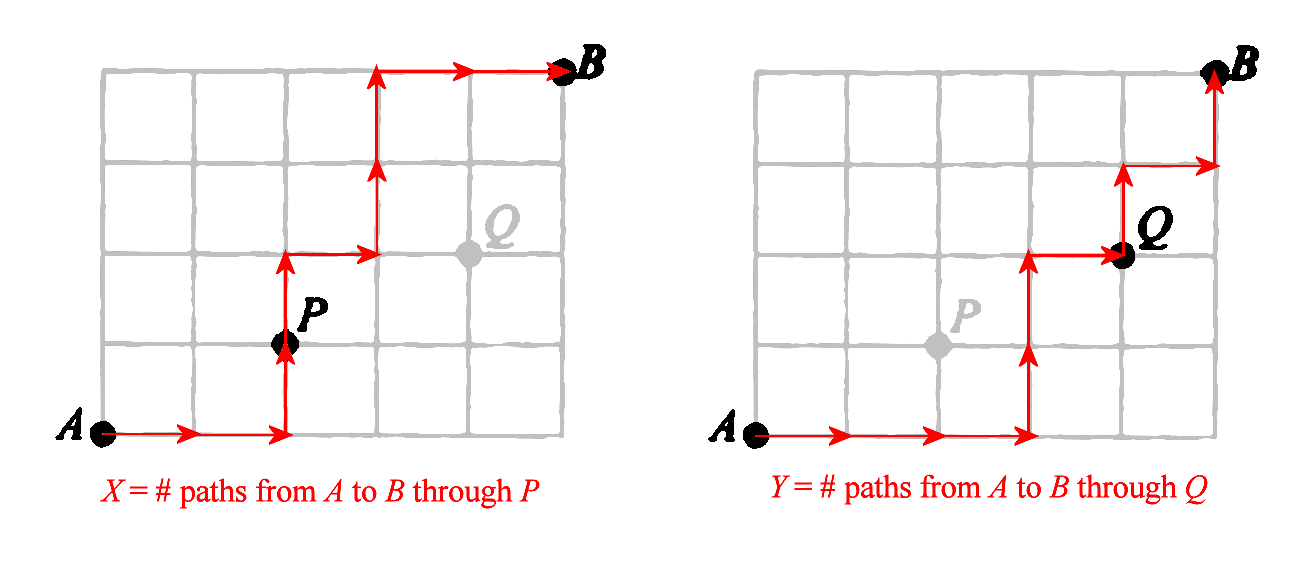
     First, let us note that every path from  A  to  B  is equivalent to a sequence of right arrows (®) and up arrows (á).  In the above example, the path corresponds to a sequence “®áᮮᮮá”.  There are  9  symbols in each sequence, of which  5  must be “go right” and  4  must be “go forward”.  [H12* Think of a related problem]  The number of such paths is
          W = # of paths from  A  to  B  = 9C4  = 9C4  =  126.

However, we do not want the paths that pass through  P  or  Q.  So we need to consider
          X = # of paths from  A  to  B  passing through  P
          Y = # of paths from  A  to  B  passing through  Q

The problem is, if you added these, the paths that pass through  P  and  Q  would have been double-counted.  So we also need to consider
          Z = # of paths from  A  to  B  passing through  P  and  Q
The required number of paths would be  W – (X + YZ) = WXY + Z.  Let us calculate part by part.
          X = # of paths from  A  to  B  passing through  P
             = (# of paths from  A  to  P) ´ (# of paths from  P  to  B)
             = 3C1 ´ 6C3  = 3 ´ 20 = 60
          Y = # of paths from  A  to  B  passing through  Q
             = (# of paths from  A  to  Q) ´ (# of paths from  Q  to  B)
             = 6C2 ´ 3C2  = 15 ´ 3 = 45
          Z = # of paths from  A  to  B  passing through  P  and  Q
             = (# paths A  to  P) ´ (# paths  P  to  Q) ´ (# paths  Q  to  B)
             = 3C1 ´ 3C1 ´ 3C2  = 3 ´ 3 ´ 3 = 27
The paths from  A  to  P  are chosen independently from the paths from  P  to  B.  That is why we are able to multiply the numbers.  Likewise, the other multiplications are justified because of independence.  Putting everything together,
                 # of paths from  A  to  B  passing through neither  P  nor  Q
             = WXY + Z = 126 – 60 – 45 + 27 = 48   J

H02. Use a diagram / model
H09. Restate the problem in another way
H10. Simplify the problem
H11. Solve part of the problem
H12* Think of a related problem

Suitable Levels
* GCE ‘A’ Level H2 Mathematics (“Permutations and Combinations”)
*  IB Mathematics HL / SL (“Counting Principles”)
* Primary School Mathematics Olympiad
* anyone, young or old, who is interested in thinking


Monday, January 16, 2012

JCCDQBHWHSS076 Telescoping Sum and Inequalities

[original source unknown]


Introduction
     In keeping the spirit of discussing genuinely “hard core” Singapore school mathematics (not “Singapore Math”, the Americanised parody) in this blog, I discuss a particularly “pernicious” problem on summation, taken from a book whose authors did not bother to credit the questions’ source.  Aside: Do you wonder why these guys never get caught for copyright infringement, and why they can get away with selling these books blatantly at a popular book chain?  My theory is that the police officers or lawyers themselves have children who are also struggling with maths … and they “need” these examination-paper compilations … so … .
     Anyway, do not be overwhelmed when you encounter a question like this that seems out of your reach.  Good problem solving involves not just regurgitating formulas and performing set procedures, but knowing how to react when one encounters unfamiliar problems.  There are also some examination-paper compilations (illegally) sold at road-side stalls at various places in Singapore.  They often provide full solutions copied straight from teachers’ marking schemes.  However, even if you have the full solutions, they may not explain how these solutions were obtained.  In this article (as in others), I will reveal how we can tackle hard questions like this using metacognition and heuristics


First Part of the Question

Stage 1 – Understanding

What are you required to do?
     I am required to show that the first expression is equal to the second one.

Stage 2 – Planning

What can you do?
     This looks like a partial fractions problem.  However, it looks pretty nasty.  We have two quadratic denominators …  Are they factorisable?  No, at least not with “nice numbers” (integer coefficients) … which means we might need something like  An+B  over  n2 – 3n + 1 and then  Cn+D  over  n2 + n – 1.  Then we solve for four unknowns  A, B, C, D.  Yulk!  This does not look like fun.

Is there another way or a better way? 
     Hmmmm … *thinking hard* … We do not really need to solve for A, B, C and D.  Actually we can think of this “show/ prove” question as something in which the answer is already given (viz. the second expression).  We need to show that the first expression is equal to this.  But we can do it by doing it the other way round.  If we can show that the second expression is equal to the first expression, then of course the first expression is equal to the second expression.  Bingo!

Stage 3 – Execution

Figure 1 – 1st part of the question
Comment: Most of this is just secondary school algebra, which JC students are expected to be adept at already.  Mentioning the “Symmetric Law of Equality” (not in any Singapore school syllabus, but it is just “common sense” made to look more official) is meant to impress teachers and convince the die-hard skeptics that this “unorthodox” method is indeed a valid method.  But then, most likely, the “unorthodox” teacher who set this “unorthodox” exam question probably expected you to do it by this “unorthodox” method anyway.


Stage 4 – Evaluation

Have you done it correctly? 
     Yeah!  Got it, as required!

Second Part of the Question

Stage 1 – Understanding

What are you required to do?
     To find (i.e. evaluate) the expression given in sigma (S) notation.

What will the answer look like?  Will it be a number?
     No.  It will be an expression ...  In terms of?  … capital ‘N’.  What about the small ‘n’?  This is just the summation index, which is a dummy variable i.e. it is a temporary “use-and-then-throw-away” variable for the sigma notation, but it will not appear in the final answer.

What concept is this part of the question testing you on?  How do you know?
     This part of the question is testing me on “the Method of Differences” technique (also known as “the Telescoping Sum” technique).  I know this because it is a favorite technique of the teachers and ‘A’ level examiners, as a huge variety of questions can be set based on this technique.  Actually the major clue is in the first part of the question, where a difference between two expressions is involved.  The minus ‘–’ sign in the second expression is the dead giveaway, the “smoking gun”.

Stage 2 – Planning

What are you going to do?
     Once I have diagnosed this problem as a “method of differences” problem, it is just a matter of following the SOP (Standard Operating Procedure):  Expand the sigma notation by writing out explicitly the first few terms and the last few terms.  Then look for a cancellation pattern.  After cancelling, there will be some terms from the front bit and some terms from the end bit remaining.

Stage 3 – Execution

     Some rough working seems necessary:-
When  n = 3:   n2 – 3n + 1  = … =  1,   n2 + n – 1   = … = 11
When  n = 4:   n2 – 3n + 1  = … =  5,   n2 + n – 1   = … = 19
When  n = 5:   n2 – 3n + 1  = … = 11,   n2 + n – 1   = … = 29
When  n = 6:   n2 – 3n + 1  = … = 19,   n2 + n – 1   = … = 41

When  n = N – 1: 
   n2 – 3n + 1  =  (N – 1)2 – 3(N – 1) + 1  =  N 2 – 5N + 5
   n2 + n – 1   =  (N – 1)2 + (N – 1) – 1   =  N 2N – 1
When  n = N
   n2 – 3n + 1  =  N 2 – 3N + 1
   n2 + n – 1   =  N 2 + N – 1

Figure 2 – Telescoping Sum Method (a.k.a. Method of Differences) 


From the given expression (line #1), we replace the summand by the difference expression (line #2) found in the earlier part of the question.  We expand the sigma notation by writing out the first four differences  (by substituting n = 3, 4, 5, 6)
and the last two differences  (by substituting n = N–1, N).  From experience, I know that I can see the pattern more clearly if I write the terms neatly, devoting one row per value of n I substitute.  Indeed once I do that, the cancellation pattern becomes obvious.  In the last two lines, I collect the remaining (uncancelled) terms and simplify the resulting expression.

Stage 4 – Evaluation / Checking

Are you correct?  How do you check?
     Yes.  I can check by substituting, say, (capital letter) N = 3, 4, 5 and seeing if the expressions agree.


Third (Final) Part of the Question

Stage 1 – Understanding

What are you required to do?
     To show that the given sum to infinity is less than 1.

What type of question is this?
     This is a “show / prove” question involving inequalities and sum to infinity.

Stage 2 – Planning

Do you notice anything?  How is it connected to the earlier part(s) of the question?
     This looks hard.  The connection (if any) is not obvious.

What are you going to do about it?
     There is a pattern.  I’ll solve part of the problem (this is a heuristic) by considering a finite sum first.  Later on, I can let  N®¥  to get the sum to infinity.  I rewrite it in sigma notation to try to see if there is any connection with the previous part.  I need to slowly manipulate this (“massaging the expression”) to make it look like the expression in previous part.  But … hmmm … this looks quite different from the earlier sigma expression …
Figure 3 – Using finite sum and sigma notation
What are the differences?  Can you point them out?
Figure 4 – Doing a comparison (“Spot the differences”)

     (D1) instead of starting from  n = 3, this sum starts from  n = 1
     (D2) there is no ‘2’ in the numerator, unlike the previous summation
     (D3) there is no ‘(2n –1)’ in the numerator, unlike the previous summation
     (D4) in the denominator, the smaller quadratic is  n2  instead of  n2 – 3n + 1
     (D5) in the denominator, the larger quadratic is  (n + 1) 2  instead of  n2 + n – 1
Hmmmm … it looks like the person who set this question has set up a minefield.  If I get it wrong in any one of the above, the question will blow me off.

Don’t panic.  What heuristic can you use?
     I can split this big problem into smaller problems.  I can handle it a step at a time.

So how can you handle (D1)?

     I can write out the first two terms explicitly and start the summation from  n = 3.
How do you that?  Just substitute n = 1  and then  n = 2  into the summand’s formula to get the first two terms.  For the rest of the terms, I write it in a similar sigma form, but starting from n = 3.

Stage 3 – Execution
Figure 5 – dealing with the big problem in smaller steps

Back to Stage 2 – Planning

Good.  Now, how do you deal with (D2)?

     I can forcefully introduce a ‘2’ in the numerator, and compensate that by putting a factor of ½, which can be written outside the summation.  Further, I can also evaluate ¼ + 1/36, which is  10/36.


Stage 3 – Execution
Figure 6 – dealing with the 2nd sub-problem

Back to Stage 2 – Planning

Now, how to deal with (D3)?
     I can forcefully introduce a ‘(2n –1)’ in the numerator …

But wouldn’t that be different from the previous equation?
     Yes.  In fact, the new expression would be bigger.  Why?
For  n = 3, 4, 5, …,  each of the  2n –1  will be at least 5 … definitely more than 1.  Multiplying with the positive summands, each term in the summation will be bigger than before.  Hence the resulting summation will be bigger than the previous line’s summation.  That means I need to replace the ‘=’ sign with the ‘<’ sign.

Stage 3 – Execution
Figure 7 – dealing with the 3rd sub-problem


Back to Stage 2 – Planning

How to deal with (D4) and (D5)?
     Now this is a tough cookie … hmmm …

Can you compare the pairs of denominators?  For (D4), which is bigger one?
     Comparing  n2  with  n2 – 3n + 1,  it looks like the latter is smaller because there is a minus  3n.  So  n2  is larger.  By how much?  If  n2 – ¿¿¿ = n2 – 3n + 1,
what is the ‘¿¿¿’?  By inspection (i.e. fiddling with the algebra) we observe that
     n2 – (3n – 1) = n2 – 3n + 1
So the  ‘¿¿¿’ is  3n – 1.  Is this positive?  Yes, for n = 3, 4, 5, …, this is at least 8.  Definitely positive.  Which means  n2  is indeed greater than  n2 – 3n + 1, and it is bigger by  3n – 1.


What about (D5)?
     (n + 1) 2  is the same as  n2 + 2n + 1.  Hence
     n2 + n – 1 = (n + 1) 2n – 2 = (n + 1) 2 – (n + 2)
That means  (n + 1) 2  is more than  n2 + n – 1, and it is bigger by  (n + 2).

So, are the target denominators  n2 – 3n + 1  and  n2 + n – 1   bigger or smaller than what we have currently?  These denominators are smaller.

Will the resulting expression be bigger or smaller?
     By the “Monk-Porridge Theorem”, since we are dividing positive quantities by smaller divisors, we will end up with a larger quantity.  So we link to the resulting expression with a ‘<’. 

Stage 3 – Execution
Figure 8 – dealing with the last two sub-problems

Stage 4 – Evaluation

Does this make sense?
     Yes.  This inequality sign ‘<’ is in the same direction as the previous one.
We are using the Law of Transitivity: if  a < b  and  b < c  (conventionally we write this as  a < b < c), then  a < c.  If the inequality signs are in different directions (say,  a < b  and  b > c), then we are in trouble, because we cannot conclude that  a < c.  Here, the inequality signs point the same way, so we are good.  We can go back to stage 3 to complete the rest of the calculations.


Back to stage 3 – Execution
Figure 9 – completing the question


     In line #1, we simplify the previous expression.  Then using the earlier result obtained from the second part of the question, we replace the sigma expression with its equivalent, shown in line #2 between the curly braces.  We have two expressions that are reciprocals of quadratics in ‘N’.  Obviously, these become smaller and smaller as  N becomes larger and larger.  In other words, these terms tend to zero as  N  tends to infinity (line #3).  Hence the infinite sum will tend to something less than 79/90 (we can work this out from the line #2 expression).  This is definitely less than 1, which is what we are supposed to demonstrate.


Final Presentation (for the last part of the question)
Figure 10 – putting it all together

Step 5 – Reflection

What did you learn by doing this question?

     I learned that, once again, metacognition and heuristics are useful for the 5-stage problem solving process.  For a complicated problem, one does not have to proceed with the five stages in a strictly linear fashion.  Instead of trying to regurgitate a fixed technique where there is none, I can go back and forth (especially between stages 2 and 4), thinking, doing and re-thinking along the way.  This is the usual way expert mathematics solvers actually solve their mathematics problems, not that they have a method that automatically proceeds from start to finish.
     From the first part of this question, I learned to look out for shortcuts.  We can use the Symmetric Law of Equality (A = B Þ B = A) instead of doing things by the usual way (partial fractions).
     From the second part of this question, I learned to be aware of questions that test the “Method of Differences” (or the “Telescoping Sum” technique).  In this question, the tell-tale giveaway clue is the ‘–’ minus sign.  Once you know it is the “Method of Differences”, the execution of this technique is rather standard.  Write out the terms by substituting the first few values of the summation index (n in this case) and the last few values.  Use one row per value of  n, so that the cancellation pattern can be seen more clearly.  After all the gory cancellations, a few of the first terms and a few of the last terms remain.
     For the last part of the question, I learned to keep calm in the face of difficulties.  I learned to simplify the question and rephrase the question (e.g. by rewriting it into sigma notation).  I look for patterns.  I learned that making comparisons (“what I have” vs “what I want”) is a powerful heuristic that can suggest what steps to take next.  I also learned that a complicated question can be tackled by breaking it down into smaller, more manageable sub-problems.  Then I deal with these sub-problems systematically.

What about you, the reader?  What did you learn from this problem?


Remarks
     The term “Telescoping Sum” comes from the observation that when applying the method of differences, you begin with a long expression like a telescope that is stretched out.  After cancellation of the terms in the middle, the expression is being shorted – just like compressing a telescope.