Showing posts with label construction line. Show all posts

Saturday, November 7, 2015

[S1_20151107PAXA] Angle between two Aussie Fifty Cent Coins

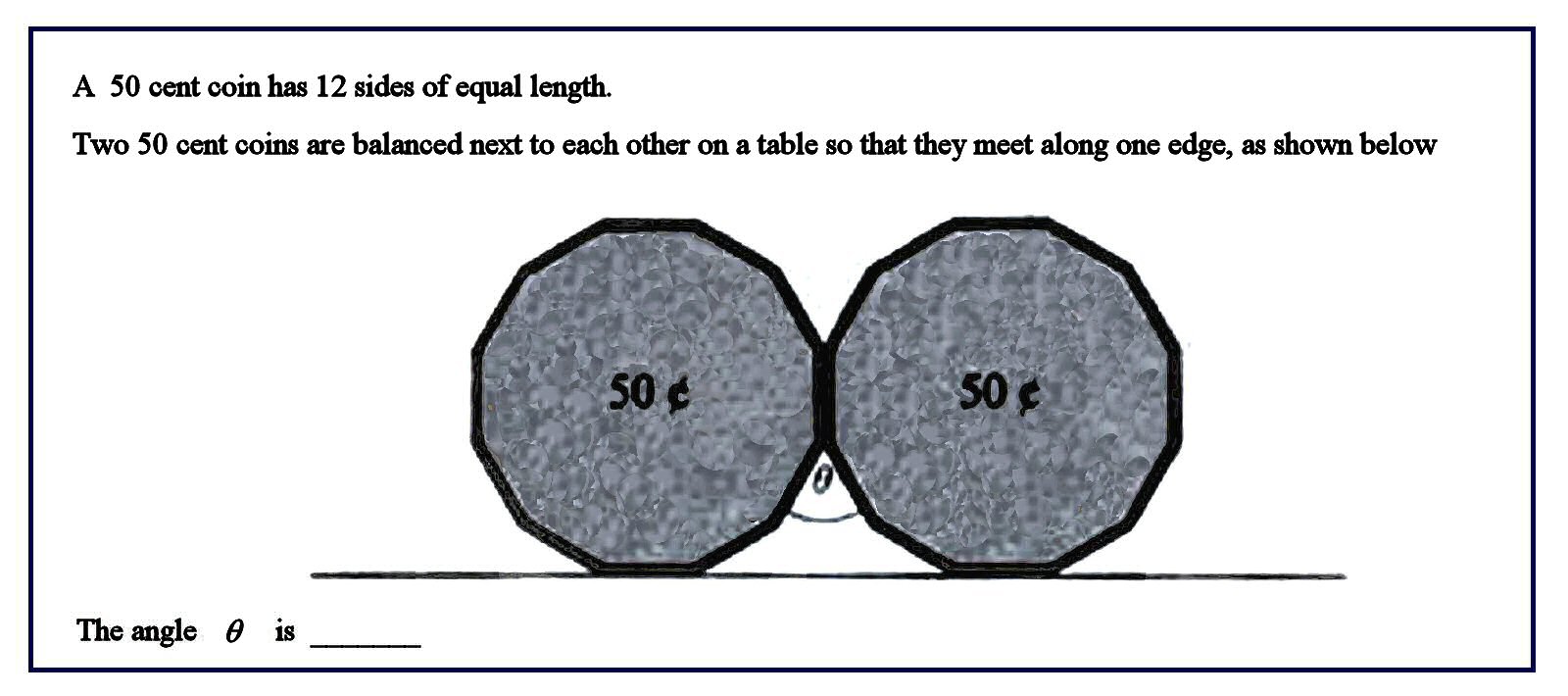
Question

Introduction
     This question appeared as Question 7 of this year's Australian VCE Further Mathematics Examination.  It has caused an uproar among some students who sat for the examination, hurling abuse at “50 cent”.  For a moment I was wondering: why should the eponymous American rapper face the music for an exam question he never set?  Hmmm...
     Anyway, in Singapore, this type of problem belongs to just the plain old Lower Secondary Mathematics syllabus for the topic of angles and polygons, usually taught in secondary 1 (equivalent to about grade 7 or 8).  There is no “additional” or “further” mathematics in our lower secondary curriculum.  Students who do well can opt to take Additional Mathematics.  In the Integrated Programme schools, they may call their mathematics curricula by different names.
     I would say this question would be of intermediate difficulty level in Singapore.  It is not so straightforward, but there is a quick solution, given the right insight.  How can we obtain the right insights?  This can be done by making observations and splitting a problem into smaller problems!  [Heuristics H04, H10, H11]

Important Principles
     Let us do some recap.  A polygon is any closed shape consisting of a number (at least three) of straight edges.  An exterior angle of a polygon is obtained by producing (extending) an edge in one direction – it is the angle between this extended edge and the next nearby edge.  It is a fact that
the sum of all exterior angles of any polygon is always 360°
This can be proven in various ways, but I think the best way to see this intuitively is to imagine that you are an ant on the polygon.  Starting from any vertex, go along the edges and every time you walk on a new edge, you turn by an amount equivalent to the exterior angle.  By the time you have come back round to your starting point, you would have turned a total of  360°[H01]
     By its construction, the exterior angle and its interior angle always add up to 180°.  For a regular polygon  with  n  sides, all its sides (edges) are equal and all its interior angles are equal and so all its exterior angles are also equal.  Then it is immediately obvious that
each exterior angle of a regular n-sided polygon is 360° ¸ n

Solution
     We construct a vertical line segment in the middle and focus on, say, the right half of the angle (shown highlighted in magenta).  [H09, draw an “imaginary” line]
     This half-angle is in fact an exterior angle of the 50 cent coin (a 12-sided regular polygon) and so it measures 360° ¸ 12 = 30°.  Thus the value of  q  is double that, i.e.  60°[H09]  Done!

Remarks
     If you have three such 50-cent coins, you can actually put them together and you see a triangular hole in the centre.  [H01]  This is actually an equilateral triangle and each angle would be 180° ¸ 3 = 60°.   I am sure even a ten-year-old kid can do this!


H01. Act it out
H02. Use a diagram / model
H04. Look for pattern(s)
H05. Work backwards
H09. Restate the problem in another way
H11. Solve part of the problem

Suitable Levels
Singapore Lower Secondary Mathematics (Sec 1 » Grade 7/8)
Victorian Certificate of Education Further Mathematics (Australia)
* other syllabuses that involve polygons and angles
* whoever is interested, even 10 year-old kids


Saturday, March 7, 2015

[Pri20150306PPP] A Perspective for Perplexing Parallelograms

Question

Comprehension
     Let us first be clear about what is given in the problem.  I have indicated the numerical values of the areas in the diagram below.

Planning
     First we construct  HK  parallel to  AB  passing through  E[ Heuristics H02 & H09 ]  This makes the problem easier to solve because there are congruent triangles and there are connecting ratios along the sides of the parallelogram as well as along the diagonal.  Namely  BF : FA = BE : ED = BK : KC.  We denote the  Area of DBKE by  x, and observe that it is the same as  Area of DBFE  by congruency (you can shift and rotate  DBKE  to get  DBFE).   Area of DAHE = Area of DAEF = 1 cm2  because of congruent triangles.  [ H04 ]

     Let us try to figure out  x [ H11 ].  Making further observations [ H04 ], note that  Area of DADB = Area of DCDB (big congruent triangles) and Area of DHDE = Area of DGDE  (congruent triangles).  See diagram below.


     Because of all these congruent triangles, the parallelogram AHEF and EGCK are forced to have the same areas (area measures), even though they may not be congruent:-
      Area EGCK = Area DCDB – Area DGDE – Area DBKE
                           = Area DADB – Area DHDE – Area DBFE 
                           = Area AHEF = 2 cm2.
We conclude that  Area DBKE = Area DBFE = 13/5 – 2 = 3/5  [cm2].  [ H05 ]

Here is the important thing:-

If triangles/parallelograms have the same height, their area ratio equals their base ratio.
     [ This is different for similar triangles/parallelogram. Do not confuse these two situations. ]

     Area DBFE : Area DAEF = BF : FA = BE : ED = BK : KC  = 3 : 5.
Now we can quickly fill in the areas of the remaining pieces as follows:-

      Area ABCD = 2 ´ Area DABD = 2 ´ (3/5 + 2 + 5/3) = 8 8/15  [cm2]   Done!

H02. Use a diagram / model
H04. Look for pattern(s)
H05. Work backwards
H09. Restate the problem in another way
H11. Solve part of the problem

Thinking Back

     After solving a problem (especially a difficult one), it is always good to think back and recollect what we have learnt by solving the problem.  We have used the following important geometrical facts

#1   If two shapes are congruent (that means you can shift, rotate and/or reflect so
       that they coincide), then their areas are equal.
#2   If triangles/parallelograms have the same height, their areas’ ratio equals their
       bases’ ratio.
#3   Sometimes, two shapes can have the same area even if they are not congruent.

      Drawing a construction line splits the diagram into various parallelograms and triangles with the same height, for which we can compare the ratios.  Using congruent triangles, we realise that two of the smaller parallelograms have the same area even though they are not congruent.  With the right perspective, we can deal with these perplexing parallelograms.  Using comparison, we found the area of the small triangular piece  x, and from there we use fact #2 above to work out the rest.