Showing posts with label elementary. Show all posts

Saturday, October 22, 2016

[Pri1_20161021DIV] Labelling as a strategy for Division

Introduction
          The Singapore mathematics syllabuses are very well designed, especially the primary school syllabus.  Fundamental concepts and skills are introduced before going on to complex calculations and problem solving.  At primary 1, pupils learn the idea of multiplication and division of small numbers by grouping (or partitioning).  They are not made to recite the times tables meaninglessly.
          Division is easy if the number of things in each group is known.  You just keep on circling the known number of objects until everything is circled.  However, if the number of groups is required but the number of things in each group is not given, and if the objects are not arranged in a convenient way, the task can be a bit more challenging.  Remember: they have not memorised the multiplication tables yet.

Problem / Question


Solution (Suggested)
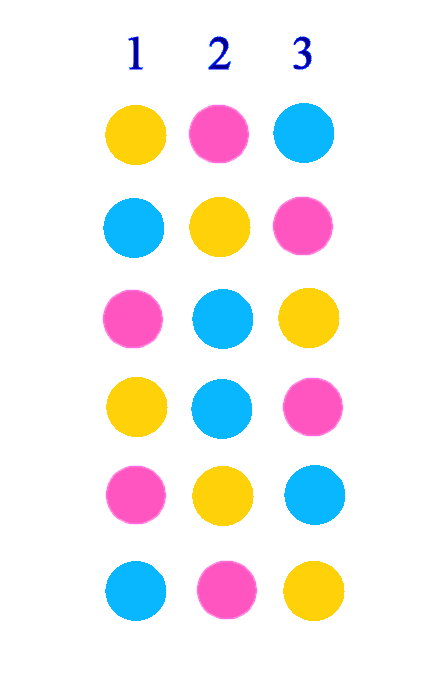
          One way to solve this problem is to label the fish 1, 2, 3, 1, 2, 3, ... in a cyclic fashion, assigning fish to each of the three friends one at a time, thereby ensuring that each person gets the same number of fish.  Start with “1” somewhere on the left, “3” on the right and “2” somewhere in the middle.  Assign the next “1” close to the previous “1”, the next “2” close to the previous “2” and the next “3” close to the previous “3”.  So all the 1s are close together, the 2s are close together and the 3s are close together.  After all the fish have been labelled, the partitioning (or grouping) becomes obvious.

H02. Use a diagram / model
H04. Look for pattern(s)
H09. Restate the problem in another way

Suitable Levels
* Primary School / Elementary School Mathematics
* any precocious or independent learner who is interested


Thursday, May 28, 2015

[NumTh Expository] Divisibility Tests for 7 and other digits

Introduction
     Let  n = ...ABCDEFG = ... + A´106 + B´105 + C´104 + D´103 + E´102 + F´10 + G. 
I invent the notation  ‘n ¸ d’  to mean  “n  is divisible by  d”  (as integers).  For a definition
n ¸ d   Û   d | n   Û   n = kd  for some integer  k
Many of you may have heard of the following divisibility tests:-
  n ¸ 1   is always true
  n ¸ 2   Û   the last digit  G ¸ 2   Û   the last digit  G Î {0, 2, 4, 6, 8}
  n ¸ 3   Û   the sum of digits  ... A+B+C+D+E+F +G ¸ 3
  n ¸ 4   Û   the last digits  FG ¸ 4
  n ¸ 5   Û   the last digit  G ¸ 5   Û   the last digit  G Î {0, 5}
  n ¸ 6   Û   n ¸ 2  and  n ¸ 3  (see above)
  n ¸ 8   Û   the last digits  EFG ¸ 8
  n ¸ 9   Û   the sum of digits  ... A+B+C+D+E+F+G ¸ 9
n ¸ 10   Û   the last digit  G = 0
What about divisibility by 7?

Modulo Arithmetic
     Divisibility tests are all based on modular arithmetic (a.k.a. clock arithmetic), as part of number theory.  This arithmetic was developed initally by a very clever mathematician
called Carl Friedrich Gauss.  The key idea is that numbers can be grouped into separate classes.  For example, when considering division by  3,  we can split the integers into three equivalence classes called residue classes
     [0] = { ..., -3, 0, 3, 6,   9, 12, ... }
     [1] = { ..., -2, 1, 4, 7, 10, 13, ... }
     [2] = { ..., -1, 2, 5, 8, 11, 14, ... }
The members of each class have the same remainder when divided by  3.  For example 
     10 ¸ 3 = 3r1,  7 ¸ 3 = 2r1,  4 ¸ 3 = 1r1  (all the remainders are equal to 1).
So  10, 7, 4, 1 ... etc are all members of the class  [1]  represented by  1.  Members of the same class are called congruent.  For example  10 º 4 (mod 3),  read as “10 is congruent to  4  modulo 3” and it means  10  and  4  have the same remainder when divided by  3.
a º b (mod m)   Û   (a – b) ¸ m   Û   a = b + km  for some integer  k
As you know,  “a ¸ m  gives a remainder of zero”  means  “a  is divisible by  m”.  Hence
a º 0 (mod m)   Û   a ¸ m
Congruency (for a given modulo m) is a type of equivalence relation.  We have these laws
Reflexivity:   For every integer a,  a º a
Symmetry:    If  a º b,  then  b º a.
Transitivity: If  a º b  and  b º c,  then  a º c.
These properties are similar to ‘=’.  We also have some very neat arithmetical laws.
Suppose  a º b (mod m)  and  c º d (mod m).  Then
     a + c º b + d  (mod m)
     a – c º b – d  (mod m)
         ac º bd      (mod m)

For a given number  n = ...ABCDEFG,  we can write  n = 1000x + y   where  x = ...ABCD,  y = EFG.  With the above laws, modular arithmetic helps simplify calculations and provide powerful insights.  For example, in modulo 8,
         10 º 2,  100 º 102 º 22 º 4,  1000 º 10 ´ 102  º 2 ´ 4 º 0.  Hence
         n = 1000x + y  º  0×x + y  º  y.
This explains the divisibility test by  8:  To see if a number is divisible by  8, we just need to look at the last  3  digits  y = EFG.

Test for divisibility by 7
     Using modulo 7,  10 º 3,  100 º 32 º 2,  1000 º 3 ´ 2 º 6 º -1.
     n = 1000x + y º  -1×x + y º  y – x.  Thus
     n ¸ 7   Û   n º y – x º 0   Û   x º y   Û    x – y ¸ 7.  We have the rule
n ¸ 7   Û   ...ABCD º EFG (mod 7)
This means that a number is divisible  7  if (and only if) after breaking off the last three digits, both resulting pieces have the same remainder when divided by  7.

Example 1
       For 12 516:  12 º 5  and  516 º 5 (mod 7).  So  12 516 ¸ 7.

Example 2
       For 654 321:  654 º 3  and  321 º 6 (mod 7).  So  654 321 not ¸ 7.

Example 3
       For 1 494 787:  787 º 3 º 1494 (mod 7).  So  1 494 787 ¸ 7.
       Alternatively, 1 494 – 787 = 707 ¸ 7.  So  1 494 787 ¸ 7.


Works like magic, doesn’t it?

Sunday, May 10, 2015

[PriCNPTGN_20150508] Sum of the First Few Natural Numbers

Question

 Introduction
     Numerical patterns are a challenge to learn and to teach.  Those of us who are teachers, usually the better students of our time, tend to think that the pattern is “obvious”, and hence do not bother to explain and/or facilitate classroom discussions regarding patterns.
     This article is about a pattern that involves the sum of the first few natural numbers (or wholenumbers).  This pattern, common in our primary school mathematics patterns, is a special case of the sum of an arithmetic progression, but its formula is not usually taught explicitly.  The story is told of the great mathematician Karl Friedrich Gauss, who figuredout a short-cut for adding up  1 + 2 +... + 100.  Lesser mortals in primary schools are left to struggle with frustration, or to copy “model answers” from their tutors or teachers without understanding how the solutions were obtained.
     As in a previous article, I attempt to illustrate the pattern visually.  I shall highlight the linkages to facilitate discovery of the general method, as well as show how the last part (part(c)) can be solved.

Solution
     Many pupils are able to deduce the answer to part (a) by analysing the differences between successive answers, which is equivalent to asking what must you add to get the next number.  For example, from the 1st number  1,  you add  2  to get the 2nd number  3,  you add  3  to get the third number  6.  To get the 4th number, you add  4  to get  10.  This approach works, but will not help you much for parts (b) and (c) of the question.  The better way is to look for a method that does not require you to keep on adding numbers.  That would allow one to kill all the birds with one stone.  How to do this?
     Imagine the given dots being doubled, rotated and then put together into parellelogram-like matrices.  If you want, you can imagine them as rectangular arrays.  I use the colour orange for the originals, and blue for the copies.

     As you can see, for figure 1, the total number of blue and orange dots is  1 ´ 2.  For figure 2, the total is  2 ´ 3.  For figure 3, the total is  3 ´ 4.  For figure 4, the total is  4 ´ 5.  The pattern is: for whatever number representing the position of the figure, the total is this ordinal number multiplied by another factor that is one more than this number.  Hence the number of original dots (shown in orange) is this product divided by  2.  With this insight, we can fill up the table to answer part (a).  The answer for figure  5  is  30.

We can also figure out that the answer to part (b) is  55,  with the above-mentioned pattern.

For part (c), we can use trial and error or “guess and check”.  Trying  21  gives  21´22 = 462  which does not work.  We try 22:  22´23 = 506.   Yes!  Bingo!

You may also use a calculator to help you.  Since the two unknown factors are close together (they differ only by one), it is almost like multiplying a number with itself, or squaring.  So to guess our number, we may use the square root (the opposite of squaring) to estimate it.  The square root of  506  is about  22.49.  We guess  22  and verify that 22´23 = 506.

Summary
     The pattern involving the sum of the first few whole numbers may be deduced by making a copy of the original figure, rotating it and joining it to form an array.  Just multiply accordingly and then divide by  2  to get the sum for the original figure.  To solve for a figure’s ordinal number (which figure has a certain given number of dots), one may use guess and check, or use square roots.  A primary school pupil should be able to all these without the knowledge of advanced techniques like the sum of arithmetic progressions or quadratic equations.


H02. Use a diagram / model
H03. Make a systematic list
H04. Look for pattern(s)
H05. Work backwards
H07. Use guess and check
H09. Restate the problem in another way

Suitable Levels
* Primary School Mathematics (algebra unnecessary)
* GCE ‘O’ Level “Elementary” Mathematics (Number patterns, with algebra)
* GCE ‘A’ Levels H2 Mathematics (Number patterns, with algebra)
* anyone who loves a challenge to unravel a pattern


Saturday, May 2, 2015

[Pri20150408YYS] Yin-Yang Semicircles?

Question


Introduction
     The diagram looks a bit like the Yin and Yang symbol, doesn’t it?  This problem can be solved easily using the correct insights.  I present two solutions: the first one is by direct calculation (in terms of p), and the second solution uses the powerful concept of ratio of similar figures.
     Whichever method is used, first we must make observations.  Can you see that there are three types of semicircles (small, medium and large)?  [H02, H04]

Let  S = area of small semicircle,  M = area of medium-sized semicircle,  and  L = area of large semicircle.

Note that  area of A  = area of C  = L – M + S,  and  area of B = 2´(M – S).  [H10, H11]

Solution 1 (by direct calculation)
     L = ½p(3)2 = 9p/2.   M = ½p(2)2 = 4p/2.   S = ½p(1)2 = p/2.
     area of A  = area of C  = 9p/2 – 4p/2 + p/2  =  3p
     area of B = 2´(4p/2 – p/2) =  3p
\ area of A : area of B : area of C  =  1 : 1 : 1.  (The areas are all the same)
Many pupils feel more comfortable using concrete approximations like  p  » 22/7  or  p  » 3.14,  but this tends to obscure relationships between entities, and makes the calculations messier.

Solution 2 (using similar shapes)
     An powerful idea is that the ratio of areas of similar shapes is the square of the ratios of their lengths.  When a figure is enlarged by a factor of (say) 5, we get a similar figure and the area becomes  52 = 25 times as large.  So  M = (2)2S = 4S  because the radius of the medium-sized semicircle is twice that of the small semicircle.  Likewise,  L = (3)2S = 9S.
     area of A  = area of C  = 9S – 4S + S  =  6S
     area of B = 2´(4S – S) =  6S
\ area of A : area of B : area of C  =  1 : 1 : 1.  (The areas are all the same)

Commentary
     The second solution is neater because we do not need to deal with fractions or with p.  The  ratio of areas of similar shapes is the square of the ratios of their lengths.  This concept is in fact required knowledge in secondary school mathematics, including GCE ‘O’ level “Elementary” Mathematics.

H02. Use a diagram / model
H04. Look for pattern(s)
H10. Simplify the problem
H11. Solve part of the problem


Suitable Levels
* GCE ‘O’ Level “Elementary” Mathematics (“similar figures”)
* Primary School Mathematics (“areas”)
* other syllabuses that involve areas, ratios and or similar shapes.


Wednesday, April 29, 2015

[Pri20150429PPP] Pythagoras for Primary Pupils?

Question


Introduction
     This primary (elementary) school mathematics examination question created quite a stir among some parent support groups on Facebook.  The issue is that the height of the triangle seems to have been omitted.

Pythagoras’ Theorem
     Some participants who know secondary school mathematics were quick to suggest the use of Pythagoras’ Theorem to find the height of the triangle, which works out to be  12 cm.  This leads to the answer (2) 114 cm2,  which is correct.  The problem is that pupils are not taught Pythagoras’ Theorem until secondary school, and so it would seem an unfair test for the pupils.  So the discussion turned to thinking of various methods by which a primary school pupil may uncover the answer without resorting to advanced knowledge.

Elimination and Educated Guessing
     Mr Teo Kai Meng, a tutor who regularly participates in the support groups, offered some insightful observations.  Assuming that the height measurement is a whole number of centimetres, only options (2) and (4) need to be considered as they were divisible by  19, which the area had to be under the said assumption.  [ Another tutor, Melissa Song had a similar idea by observing that since the triangles DKLN and DKMN  have the same height, the ratio of their areas is the ratio of their bases LN : MN = 19 : 16. ]  We can ignore choices (1) and (3).  As we know,  area = ½ ´ base ´ height .  Since teachers like to catch students for being careless in forgetting to multiply by ½  (or dividing by 2), it is quite likely that option (4) was set up as a booby trap.  Thus one may intelligently surmise that option (2) should be the answer.

     Mr K L Chua, a tutor who calls himself “Mathematics Specialist”, used a similar reasoning.  He worked backwards from each of the four choices to get the heights and chose the most plausible answer.  Of the two whole-number answers, (4) was eliminated and (2) was chosen since from the diagram the height should roughly be near to  16 cm  even though the diagram was not drawn to scale.

Scale Drawing

     Another participant suggested doing a scale drawing to estimate the height.  Indeed this can be done, and is a good tactic too, since this could be done quickly with a ruler and pencil.

A Visual Solution
     Assuming no knowledge of Pythagoras’ Theorem, it is possible to construct a visual solution.  First we take four copies (indicated in orange/light-orange) of the right-angled triangle  DLNK  and arrange them to surround a square of side  37  cm (indicated in green),  which is the same as the longest side (hypotenuse) of the said triangle.     This green area is  1 369 cm2.  Now we rearrange the triangular pieces as indicated by the red arrows.  The areas of the orangey triangles do not change when you shift them.  Neither will the green area change, since the total area everything in the containing square (orangey plus green areas) remains the same.

With pairs of right-angled triangles joined together along their longest sides, we now obtain two green squares, the larger of which has side  35 cm.  This gives an area of  1 225 cm2.  The total area of the two green squares is the same as the area of the large green sqaure before the shifting, namely  1 369 cm2.  Hence the area of the small square is  (1 369 – 1 225) cm2 = 144 cm2.


From here we quickly deduce that the unknown height is  12 cm,  12 being the square root of  144.  Hence we conclude that the area of  DKLM  is  114 cm2.

Remarks
     I have shown that it is theoretically possible for primary school pupils without knowledge of Pythagoras’ Theorem to derive the answer in an exact manner.  By the way, the method of shifting triangular pieces as indicated above can be generalised to give a proof of Pythagoras’ Theorem.
     Some parents expressed fear that this is another one of those Cheryl-like or olympiad type of problems.  Is there a conspiracy by the school teachers to purposely set difficult questions and make life difficult for pupils, disadvantaging those who cannot afford private tutors?  In this case, could this just have been an oversight on the part of the teacher who set the question?
     Entrepreneur John Low Jiayong and tutor John Lim sourced for and managed to obtain faithful copies of the original question.  It turned out that some school-paper vendors had inadvertently erased the 12 cm measurement.  Thus in the original question, the height  KN  was given as 12 cm, and the measurement of  37 cm for the hypothenuse  LK  was purposely given as extraneous information to distract students.
     Some parents observed that this is after all just a multiple-choice question that carries a credit of only one mark.  If this were an exam situation with the  12 cm omitted, it would be best to either sacrifice the  1  mark and move on, or to use tactics like elimination, educated guessing or estimation with scale drawing.
     Anyway, it had been quite a fruitful discussion, as adults (parents and tutors) attacked this problem from many angles in a purposeful way.  Many parties put in concerted effort and contributed in an engaged matter.  It would be good if this type of rich discussion were enacted in our classrooms everyday among pupils and teachers, perhaps enabled by social technology.  For then, pupils would deeply learn and perhaps would not be so stressed out, nor be needing so much extra external help.  Private tutors could then move on to focus on value-added  mentorship  for 21st Century Learning, instead picking up the tab where school teachers have left off.


H01. Act it out (e.g. scale drawing)
         (as a class learning activity, pupils can use scissors to cut out paper triangles
          and physically move them around)
H02. Use a diagram / model
H04. Look for pattern(s)
H05. Work backwards
H07. Use guess and check
H08. Make suppositions
H09. Restate the problem in another way

Suitable Levels
* Primary School Mathematics
* Lower Secondary Mathematics
* any precocious / gifted pupil who wants to learn
* any person of any age interested in creative problem solving


Monday, April 6, 2015

[H2PCRP20150406] Colouring The Pentagon (Combinatorics)


Introduction
     This is a question suitable for the mainstream Junior College students taking H2 mathematics, but is some primary school olympiad question from somewhere.  Whatever!  Mathematics is for everybody, young and old.  Anybody can solve this problem if  s/he makes observations and uses the right approach and thinking skills.

An Incisive Insight
     Although this pentagon is not a regular pentagon, the colouring scheme depends just on the order of colours on the edges.  We can start from one edge and see what colours are possible.  And then we can rotate the colouring scheme around.  [ We are breaking down and simplifying the problem. ] 
     Fiddling around with various possibilities, you might realise that:-
·  you cannot have three of the same colour going round the pentagon
·  you cannot have three sets of pairs of edges with the same colour.
·  you cannot two single colours and one double colour
There must be one single colour and two pairs of doubled colours.  All colouring schemes will have a  “12123”  colouring pattern going around in a loop.  The diagram below shows an example where colour 1 = yellow (Y), colour 2 = red (R)  and colour 3 = blue (B).


Do we need to consider a “21213”  pattern?  If  “12123”= “YRYRB”, we can later reassign colours, swapping R and Y to give 1=R and 2=Y and then “12123”=“RYRYB”.  So we have got that covered.  Let us worry about the reassignment later. 

Solution
     Observe that the position of the “3” (the single colour) can be rotated round the edges of the pentagon in  5  ways.

     Observe also that there are  3! = 3 ´ 2 ´ 1 = 6  ways to shuffle the colours i.e. assign colours 1, 2 and 3  to  Y, R and B.

The above two processes (rotation and shuffling) are independent of each other.  Rotation of the single colour can be done with or without the shuffling of colours.  Hence we can use the Multiplication Principle and calculate
          the total number of ways = 5 ´ 6 = 30.
Tada!

H02. Use a diagram / model
H04. Look for pattern(s)
H09. Restate the problem in another way
H10. Simplify the problem
H11. Solve part of the problem

Suitable Levels
* GCE ‘A’ Level H2 Mathematics
* IB Mathematics HL / SL
* Primary School Maths Olympiad
* other syllabuses that include combinatorics